
ECG and Stress Tests: What You Need to Know About Heart Diagnostic Tests
- Colin Hurd
- 1 December 2025
- 15 Comments
When your doctor says you need an ECG or a stress test, it’s not because they’re being overly cautious. It’s because they’re looking for answers your heart can’t give you while you’re sitting still. These tests aren’t just routine checkups-they’re powerful tools that reveal hidden problems in your heart’s rhythm, blood flow, and function. And if you’ve ever felt chest tightness, unusual fatigue, or shortness of breath during a walk, these tests might be the key to understanding why.
What an ECG Really Shows
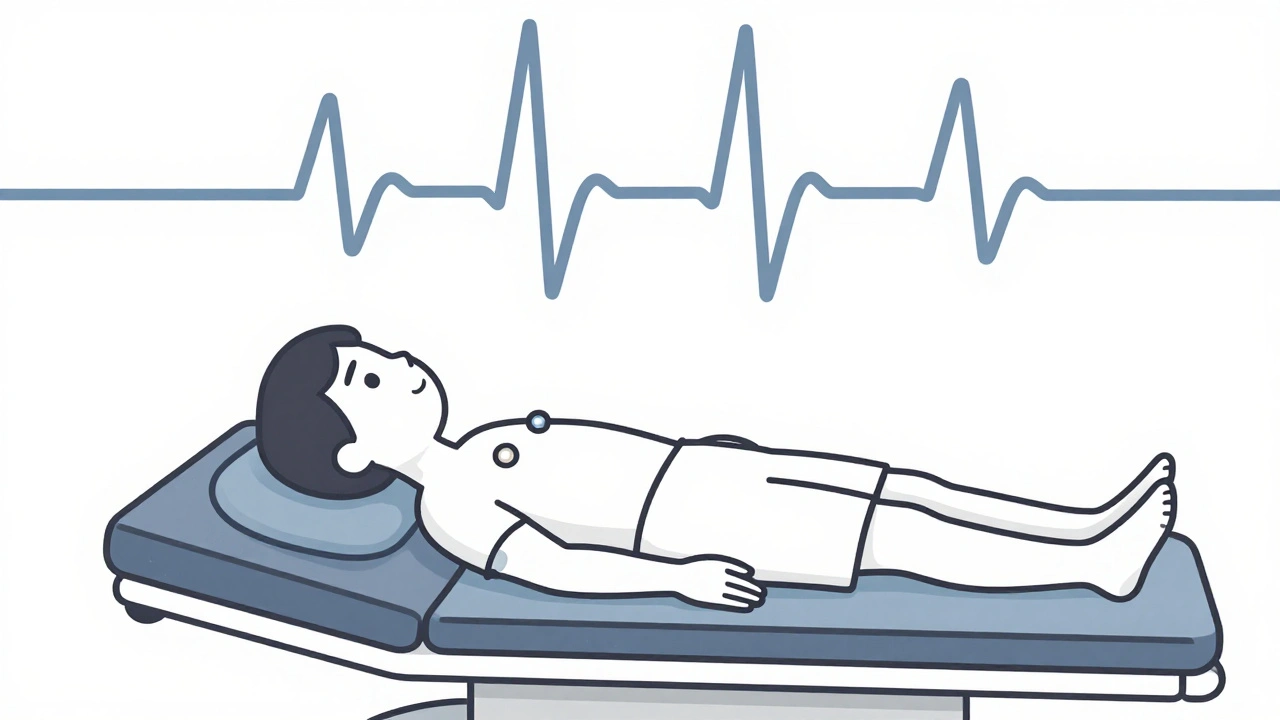
An electrocardiogram, or ECG (also called EKG), is a quick, painless snapshot of your heart’s electrical activity. Electrodes stick to your chest, arms, and legs, and in under five minutes, they record every beat. The result? A graph showing how electricity moves through your heart muscle. That graph tells doctors if your heart rhythm is normal, if you’ve had a silent heart attack, or if your heart is working too hard.
It’s not a crystal ball. An ECG won’t show blocked arteries unless they’re causing an immediate problem. But it’s the first line of defense. If your heart skips beats, beats too fast, or has an irregular pattern, the ECG catches it. It’s also one of the only tests that can detect past heart damage-even if you never had symptoms. That’s why it’s often the first thing ordered when someone comes in with chest discomfort.
Doctors rely on ECGs to spot conditions like atrial fibrillation, heart block, or enlarged heart chambers. In fact, a 2023 study found that ECGs correctly identified signs of past heart attacks in 87% of cases where imaging later confirmed the damage. That’s why even healthy people over 40 sometimes get one during a physical-it’s cheap, fast, and can catch things you don’t even know are wrong.
Why Stress Tests Are Different
Here’s the thing: your heart doesn’t always act up when you’re resting. That’s where stress tests come in. A stress test forces your heart to work harder-either by making you walk on a treadmill or by using chemicals to mimic exercise. The goal? To see how your heart handles pressure.
During a standard exercise stress test, you’ll walk on a treadmill that gets steeper and faster every three minutes. This is called the Bruce protocol. Your heart rate, blood pressure, and ECG are monitored the whole time. You keep going until you hit 85% of your maximum predicted heart rate (220 minus your age), or until you get too tired, dizzy, or chest-heavy.
Why bother? Because many people with blocked arteries feel fine at rest. But when the heart needs more oxygen during exercise, those blockages become obvious. The test can show if parts of your heart aren’t getting enough blood-a sign of coronary artery disease. It’s not perfect, though. A 2021 meta-analysis of over 24,000 patients found that standard stress ECGs catch about 68% of coronary artery disease cases. That means nearly one in three can be missed.
What Happens If You Can’t Exercise?
Not everyone can run on a treadmill. Maybe you have arthritis, lung disease, or a recent surgery. That’s where chemical stress tests come in. Instead of walking, you get an IV with a drug like adenosine or dobutamine. These drugs make your heart beat faster and harder-just like exercise.
It sounds scary, and for some, it is. People report feeling flushed, short of breath, or like their chest is being squeezed. But these effects are temporary and monitored closely. The whole process takes 30 to 60 minutes, longer than a treadmill test, but it’s just as effective for diagnosing heart problems.
Doctors often choose chemical stress tests for women, older adults, or people with mobility issues. And while the side effects can be unpleasant, they’re far less risky than skipping the test altogether. In fact, studies show that patients who can’t exercise but get a chemical stress test have the same long-term survival rates as those who can walk on a treadmill.

Imaging Tests: Echocardiogram vs. Nuclear Stress
There’s more to stress testing than just an ECG. Two advanced versions add images to the mix: stress echocardiograms and nuclear stress tests.
A stress echocardiogram uses ultrasound to take pictures of your heart before and after exercise or chemical stress. If a part of your heart doesn’t move well under stress, it’s likely due to a blocked artery. This test doesn’t use radiation, has higher specificity than standard ECG stress tests, and is especially good for women. A 2023 guideline from the American College of Cardiology now recommends it as the first choice for middle-aged women with chest pain and intermediate risk.
A nuclear stress test involves injecting a small amount of radioactive tracer-like technetium-99m-into your bloodstream. Special cameras then track how blood flows through your heart at rest and under stress. It’s more sensitive than ECG or echo, catching about 85% of blockages. But it comes with radiation exposure-about the same as three years of natural background radiation. That’s why it’s usually reserved for higher-risk cases or when other tests are unclear.
Cost-wise, nuclear tests are the most expensive-nearly $950 on average-while stress echocardiograms run around $500. CT scans are cheaper, but they show anatomy, not function. Stress tests show how your heart performs when it’s working hard. That’s the difference.
Who Needs These Tests-and Who Doesn’t
Not everyone needs a stress test. Guidelines from the American Heart Association say these tests are most useful for people with intermediate risk of heart disease-meaning a 15% to 65% chance based on age, cholesterol, blood pressure, smoking, and family history.
If you’re young, healthy, and symptom-free, you don’t need one. If you’re having a heart attack right now, you need emergency care, not a stress test. And if you’ve had a heart attack in the last two days, stress tests are too risky.
But if you’re a 55-year-old man with high blood pressure and occasional chest tightness when climbing stairs? Yes, you need one. If you’re a 60-year-old woman with fatigue and shortness of breath, but no classic chest pain? You still need one. Women often have different symptoms-like nausea, jaw pain, or extreme tiredness-and their blockages are more likely to be in smaller vessels. That’s why stress echocardiograms are becoming the go-to for women.

What to Expect Before and After
Preparation is simple, but important. Avoid caffeine for 24 hours before the test-it can interfere with the chemicals used in stress tests. Don’t eat a heavy meal two hours before. Wear comfortable clothes and walking shoes. No jewelry, no lotions on your chest.
After the test? You can usually drive yourself home and go back to work. If you had a chemical stress test, you might feel a bit off for an hour or two. That’s normal. Your doctor will give you preliminary results before you leave. A full report comes later, often with recommendations for further testing or lifestyle changes.
One patient on Reddit said, “I lasted 12 minutes on the treadmill. My resting ECG was fine. The stress test caught my silent ischemia.” That’s the power of it. A normal resting ECG doesn’t mean a healthy heart. It just means your heart is quiet right now.
The Future of Heart Testing
Technology is making these tests smarter. New AI tools can analyze ECG patterns faster and more accurately than humans. One system improved detection of heart disease by 20% in recent trials. Portable devices like the Cardiac Dynamics StressPal are now FDA-approved, letting clinics and even some GP offices run stress tests without a full lab setup.
Researchers are also using advanced ultrasound techniques to spot microvascular disease-the kind that affects tiny heart blood vessels and is common in women. These methods can now detect problems that used to be invisible.
But here’s the truth: even with all the tech, nothing replaces a good doctor who listens. If you’re having symptoms, don’t wait for a test to tell you something’s wrong. Your body speaks first. The ECG and stress test? They’re just the tools to help your doctor understand what you’re saying.
Common Myths Debunked
- Myth: ECGs detect heart attacks before they happen. Truth: They show if you’ve had one, or if your heart is under strain-but not future events.
- Myth: Stress tests are dangerous. Truth: Serious complications happen in less than 1 in 1,000 tests. You’re safer in the lab than driving home.
- Myth: If my test is normal, I’m heart-healthy. Truth: Some blockages are missed. Lifestyle still matters-exercise, diet, and not smoking are your best defenses.
- Myth: Only men need these tests. Truth: Heart disease kills more women than breast cancer. Women’s symptoms are different, and they’re often under-tested.
Is an ECG the same as a stress test?
No. An ECG records your heart’s electrical activity while you’re at rest. A stress test monitors your heart while it’s under physical or chemical stress. Many stress tests include an ECG, but not all ECGs are stress tests.
Can I eat or drink before a stress test?
Avoid caffeine for 24 hours before the test-it can interfere with the chemicals used in chemical stress tests. Don’t eat a large meal two hours before, but sipping water is fine. Always follow your clinic’s specific instructions.
How long does a stress test take?
The actual exercise part lasts 7 to 12 minutes, but the whole process-including setup, monitoring, and recovery-takes about 45 to 60 minutes. Chemical stress tests take longer, often 60 to 90 minutes total.
Are stress tests accurate for women?
Standard ECG stress tests are less accurate in women, especially younger women, because their heart disease often affects small vessels, not large arteries. Stress echocardiograms are much better for women-more accurate and no radiation. Many guidelines now recommend them as the first choice.
What if my stress test is inconclusive?
About 25% of intermediate-risk patients get inconclusive results. That doesn’t mean nothing’s wrong-it means more info is needed. Your doctor may order a stress echocardiogram, nuclear test, or even a heart CT scan to get a clearer picture.


Comments
Karandeep Singh
ecg dont detect blockages period. stress test is the real deal. why do docs even order ecg first? waste of time.
December 1, 2025 AT 23:25
Debbie Naquin
The electrophysiological signature captured by the ECG reflects transmembrane ion flux dynamics during depolarization and repolarization phases. Abnormalities in the PR, QRS, or QT intervals suggest conduction pathology, but sensitivity for microvascular ischemia remains statistically insignificant without functional stressor integration.
December 2, 2025 AT 17:18
Charlotte Collins
They call it a 'stress test' like it's some kind of punishment. Meanwhile, my heart was doing just fine until the treadmill started screaming at me like a drill sergeant. Then it started throwing tantrums. Classic.
December 4, 2025 AT 09:25
elizabeth muzichuk
I knew someone who had a stress test and they said the chemicals made them feel like their chest was being crushed by a ghost. And then they were told it was 'normal.' Ghosts don't lie. This system is broken.
December 6, 2025 AT 05:24
Bonnie Youn
You got this! I was terrified of my stress test too but I walked 14 minutes and now I’m running 5Ks. Your heart is stronger than you think. Just show up. Your body will thank you.
December 6, 2025 AT 17:58
Scotia Corley
It is imperative to note that the clinical utility of the ECG is primarily diagnostic of arrhythmias and prior myocardial infarction, not predictive of future ischemic events. The notion that it serves as a comprehensive cardiac screening tool is a pervasive misconception among the lay public, and this article, while well-intentioned, perpetuates it.
December 8, 2025 AT 10:38
Alexander Williams
Stress echocardiogram is the gold standard for women. Nuclear is overkill unless you're high risk. Why are we still using ECG-only protocols in 2024? Outdated. Inefficient. Dangerous.
December 10, 2025 AT 09:07
amit kuamr
in india we dont even have ecg machines in small clinics. people just take medicine for chest pain. no tests. no doctors. just hope. maybe that's why we live longer.
December 10, 2025 AT 12:04
Lauryn Smith
I had a chemical stress test last year. I felt weird for like 20 minutes, but the doctor said everything looked good. I still eat veggies and walk every day. Better safe than sorry, right?
December 11, 2025 AT 09:55
Margaret Stearns
My grandma had a stress test and she said it felt like her heart was trying to escape. She didn’t like it, but she’s still here. So thank you, science.
December 12, 2025 AT 16:14
Kenny Leow
As someone from Singapore, I’ve seen both the high-tech nuclear tests and the bare-bones ECGs in rural clinics. What matters isn’t the machine-it’s whether someone’s listening. The tech helps, but the human connection? That’s the real diagnostic tool.
December 13, 2025 AT 12:41
James Allen
Why do Americans spend $950 on a nuclear test when the whole world knows walking up stairs is the original stress test? If you can’t climb two flights without gasping, maybe stop pretending you’re healthy.
December 14, 2025 AT 21:20
Edward Hyde
So we pay $1000 to find out what your grandma knew from watching you eat bacon for breakfast? This is a medical-industrial complex scam dressed up as science.
December 15, 2025 AT 04:48
Mary Ngo
Did you know the FDA approved these tests after lobbying by pharmaceutical companies? The chemicals used in chemical stress tests are patented. The same companies sell the statins you’ll be prescribed afterward. Coincidence? I think not.
December 16, 2025 AT 06:10
Kelly Essenpreis
ECG is useless for women. I got a normal ECG then had a heart attack three months later. They told me I was too young. Too young to die? Maybe. Too young to be taken seriously? Definitely.
December 18, 2025 AT 00:34