
Generic vs Brand Identification in Pharmacy Systems: Best Practices
- Colin Hurd
- 31 March 2026
- 14 Comments
Every day, pharmacies handle billions of prescriptions, juggling a delicate balance between keeping healthcare affordable and ensuring every patient gets the exact treatment they need. It might sound routine, but distinguishing between a brand-name druga pharmaceutical product developed and patented by a specific manufacturer and its generic counterpart is far more complex than just checking a price tag. Misidentifying these medications within computer systems can lead to dispensing errors, unnecessary costs, and serious health risks, especially for patients on sensitive medications.
Understanding the Difference Between Generic and Brand Medications
To build effective identification practices, we first need to agree on what we are actually identifying. Under the framework established by the U.S. Food and Drug Administration (FDA)the federal agency responsible for protecting public health through drug regulation, a generic drug must be identical to an already marketed brand-name drug in dosage form, strength, route of administration, quality, and performance. When you see a generic version of a popular pill, it isn't a "watered-down" copy; it has to meet the same rigorous quality standards.
The real challenge arises because there aren't just two types of pills: the original brand and the generic. There are nuanced categories that confuse even experienced staff:
- Standard Generics: Approved via the Abbreviated New Drug Application (ANDA) pathway, demonstrating bioequivalence to the Reference Listed Drug (RLD).
- Authorized Generics: These are the exact same drug as the brand name product, manufactured by the same company but sold under a different label. They require no bioequivalence testing because they are chemically identical to the brand.
- Branded Generics: Products that went through the ANDA process but carry a proprietary trade name, such as certain oral contraceptives like Errin or Jolivette.
Why does this distinction matter for your pharmacy software? Because a standard generic requires bioequivalence proof, whereas an authorized generic is simply re-labeled. Some older systems treat them identically, which creates gaps when tracking supply chain issues or specific formulation history. As of early 2026, top-tier management systems are starting to differentiate these fields better to prevent confusion.
The Technical Backbone: How Systems Identify Medications
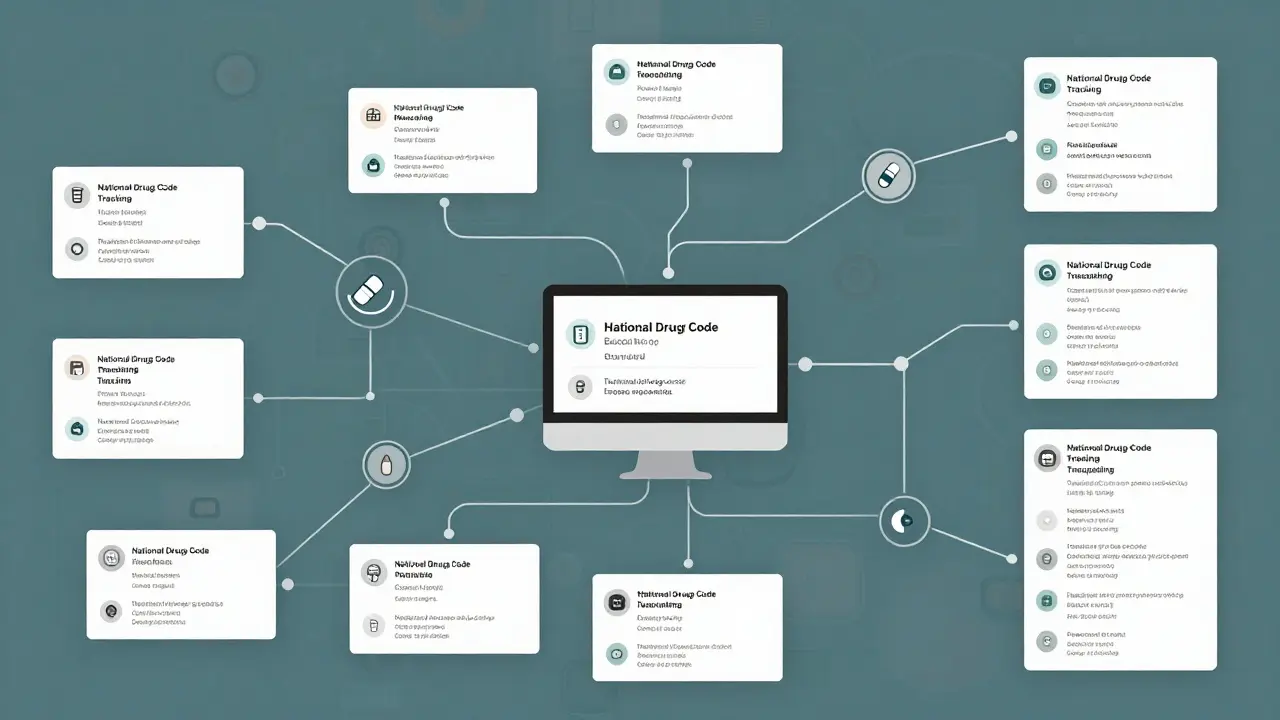
If you open your pharmacy management system today-whether it's Epic, Cerner, or Rx30-the engine running underneath relies on precise codes to distinguish products. The primary identifier is the National Drug Code (NDC)a unique 10- or 11-digit number assigned to every distinct drug product. Think of this like a serial number for each medication; every single brand version and every generic version gets its own unique string of digits.
However, relying solely on the NDC isn't enough to tell you if a drug is safe to substitute. For that, systems cross-reference the FDA's Orange Book. This database assigns Therapeutic Equivalence (TE) codes. A code starting with an "A" (like AB or AO) tells you the generic is considered therapeutically equivalent to the brand name. Conversely, codes like BX mean they might be bioequivalent but lack complete clinical equivalence due to inactive ingredients or formulation differences.
| Metric | Purpose | System Integration | User Relevance |
|---|---|---|---|
| National Drug Code (NDC) | Unique Product ID | Core Database Lookup | Ensures correct billing and inventory |
| Therapeutic Equivalence Code | Safety Check | Substitution Logic | Determines if swap is allowed |
| Bioequivalence Range | Clinical Validation | Regulatory Compliance | Confirms 80-125% confidence interval |
Most Computerized Physician Order Entry (CPOE) systems default to generic names about 92% of the time. However, the dispensing interface needs to reconcile requests. If a doctor specifically writes "Brand Medicated" or uses a specific proprietary name, the system must flag this override. In many cases, the failure isn't the medicine itself, but the software failing to communicate that a switch was made or required approval.
Managing High-Risk Scenarios: NTI Drugs and Excipients
Not all drugs play nice when switched from brand to generic. This is where safety protocols become critical. Narrow Therapeutic Index (NTI) drugs are medications where tiny changes in blood concentration can cause toxicity or treatment failure. Common examples include warfarin, phenytoin, and thyroid hormones.
Modern systems like Epic's Beacon Oncology or dedicated pharmacy modules now include specific alerts preventing automatic substitution for these high-risk categories. If a patient stabilizes on a brand-name levothyroxine, switching them to a generic variant with a slightly different manufacturing process can alter their thyroid levels significantly. A 2020 study noted that while generics are generally safe, systems often fail to capture patient-specific factors warranting brand continuation for complex medications.
Another hidden trap lies in inactive ingredients, or excipients. While the active ingredient must be the same, the fillers, dyes, and binders can differ. A 2019 study found that nearly 0.8% of patients reported adverse effects after switching from brand to generic antiepileptic drugs due to these invisible differences. Your system should ideally have a way to log allergies to specific fillers so that future prescriptions auto-check against them.

Optimizing Workflow for Patient Education
Even the most sophisticated software fails if the human element is ignored. The Institute for Safe Medication Practices (ISMP) documented adverse events related to inappropriate generic substitution, often stemming from a lack of communication rather than the drug itself. When a patient picks up their meds, they deserve to know if the physical appearance has changed.
Kaiser Permanente's member portal offers a great model here. Their "Medication Comparison" feature visually displays equivalent generics alongside brands, resulting in a 37% reduction in complaints. The key is proactive transparency. If your system shows a new generic, the workflow should trigger a script for the pharmacist to explain: "This contains the same active ingredient, but the color is different." When patients are informed, satisfaction jumps from 63% to 89%, according to Consumer Reports.
Implementing Best Practices in Your Practice
To achieve the safest outcomes, we recommend a three-tiered implementation strategy for your pharmacy team. First, configure your system defaults. You want your software to automatically select the generic option unless clinically contraindicated. This usually takes 15 to 20 hours of initial setup per workstation to link correctly with state substitution laws.
Second, prioritize staff training. Pharmacists and technicians need to understand the difference between an authorized generic and a standard one. An annual training block of 8-10 hours ensures everyone recognizes warning signs like inconsistent NDC mapping.
Finally, establish a documentation protocol. If a patient refuses a generic or has a history of intolerance, mark this clearly in the profile. In states with strict substitution laws, you may need to document the justification for brand continuation directly in the patient record to satisfy auditors.
- Audit your system's drug dictionary for accuracy against the latest monthly update.
- Set up hard-stop alerts for all NTI medications on the patient list.
- Create a visual patient handout explaining what bioequivalence means in plain English.
Is a generic drug always the same as the brand?
Yes, regarding the active ingredient. Regulations require generics to have the same strength, safety, quality, and intended use. However, differences in non-active ingredients (excipients) can occasionally affect absorption in sensitive patients.
What is an authorized generic?
An authorized generic is the exact same product as the brand-name drug but labeled as a generic. It is produced by the original manufacturer, often to compete in the lower-priced market segment without needing separate bioequivalence trials.
How do I know if a generic is safe to substitute?
Your pharmacy system should reference the FDA Orange Book TE codes. Codes starting with 'A' indicate therapeutic equivalence. Always exercise extra caution with Narrow Therapeutic Index (NTI) drugs like warfarin or levothyroxine.
Why would a system flag a brand request?
Systems flag brand requests primarily due to cost control and insurance coverage policies. However, clinicians may override this if they deem the brand formulation necessary for clinical reasons, such as patient stability on a specific source.
Does the system track excipient allergies?
Advanced pharmacy systems can track this, though it requires manual entry or specialized interfaces. Most basic setups only check the active drug name. Patients with known dye or filler allergies should keep their records updated.



Comments
James DeZego
The technical framework for identifying medications relies heavily on precise database integration. National Drug Codes serve as the foundational layer for every transaction recorded today. Without unique identifiers, billing accuracy drops significantly across all states. Therapeutic Equivalence codes provide the necessary safety checks for substitutions. An AB code confirms full bioequivalence under current FDA standards. However, BX codes indicate potential risks due to inactive ingredient variances. Software defaults often ignore these critical distinctions until manual override occurs. Staff training becomes essential to interpret these digital flags correctly. Authorized generics complicate things further because they mirror the brand product chemically. Systems must recognize these identical profiles to prevent unnecessary alerts. Excipient allergies remain a blind spot in many legacy management platforms. Patients often suffer reactions due to hidden fillers or dye agents. Narrow Therapeutic Index drugs require stricter monitoring parameters always. Levothyroxine stability depends entirely on consistent manufacturing sources. Workflow optimization starts with configuring these rules at the workstation level.
Technology supports care delivery but human oversight remains vital throughout.
April 1, 2026 AT 13:39
Molly O'Donnell
You are wrong about the Orange Book codes entirely.
April 2, 2026 AT 12:11
Rocky Pabillore
Most people completely misunderstand how pharmacy software actually functions in practice. They think it is simple automation rather than complex regulatory navigation. Real expertise requires knowing the difference between ANDA and NDA pathways deeply. Generic identification isn't just about price points or inventory slots anymore. Modern clinicians need to grasp these nuances to maintain patient safety standards properly.
April 4, 2026 AT 05:32
Callie Bartley
This situation is absolutely terrifying if insurance denies coverage suddenly!
April 4, 2026 AT 19:46
Jenny Gardner
The data! The compliance! Everything! Must align! Properly!!!
April 4, 2026 AT 23:48
Owen Barnes
I think teh main issue is just dat systems arnt updated enuf. Quillity control is super important tho. Needa fix dat mapping error fast.
April 6, 2026 AT 18:01
Christopher Beeson
Corporate interests dictate these systems more than clinical necessity does. Profit margins drive the bioequivalence testing schedules behind closed doors. We trust the FDA blindly while supply chains fluctuate wildly. Safety is an illusion sold through algorithmic assurance. The real danger lies in untracked excipient changes nobody sees.
April 6, 2026 AT 21:26
Arun Kumar
Let us remember that progress is possible through vigilance. Every team member plays a crucial role in safeguarding health. We must not lose hope in the power of proper documentation. Small changes in workflow lead to massive improvements overall. Education is the strongest tool we possess against errors.
April 8, 2026 AT 17:06
Cara Duncan
Really glad to see this topic getting attention! 👏 Communication with patients matters so much. Transparency builds trust instantly. 🌟 Everyone deserves to know what they are taking. Great breakdown of the issues here! ✨
April 8, 2026 AT 20:29
Sharon Munger
that works well enough for now
April 10, 2026 AT 08:45
Eleanor Black
Patient safety remains the paramount concern in any modern healthcare workflow. We must acknowledge the complexity inherent in distinguishing chemical formulations. Many practitioners overlook the subtle variations in excipient composition. These invisible differences can alter absorption rates significantly. A patient stabilizing on a specific brand relies on consistent delivery mechanisms. Switching sources creates unnecessary risk for vulnerable populations. Documentation protocols need to capture these specific preferences clearly. Auditors require justification for every deviation from standard substitution policies. Insurance providers often ignore clinical nuances when processing claims. Pharmacists act as the final barrier against dispensing errors here. Their expertise bridges the gap between rigid software algorithms. Human judgment provides the flexibility that machines currently lack entirely. Training staff on these distinctions ensures better outcomes consistently. Ignoring historical intolerance leads to preventable adverse events later. Comprehensive care demands attention to even the smallest formulation details.
April 11, 2026 AT 17:26
Julian Soro
That is a fantastic perspective for the whole team. We definitely need to champion these ideas harder. Let's get everyone on board with the new protocols quickly. Momentum builds when we share knowledge freely.
April 12, 2026 AT 01:53
Cullen Zelenka
Future systems will handle this automatically without friction. We just need patience during the transition phase. Better tools mean safer outcomes eventually. Keep pushing for those improvements steadily.
April 12, 2026 AT 02:06
Russel Sarong
The implications ARE staggering!!!!!! We CANNOT ignore these gaps!!!!! The industry MUST change!!!!!!
April 14, 2026 AT 01:31