
Complex Generic Formulations: Why Proving Bioequivalence Is So Hard
- Colin Hurd
- 1 January 2026
- 10 Comments
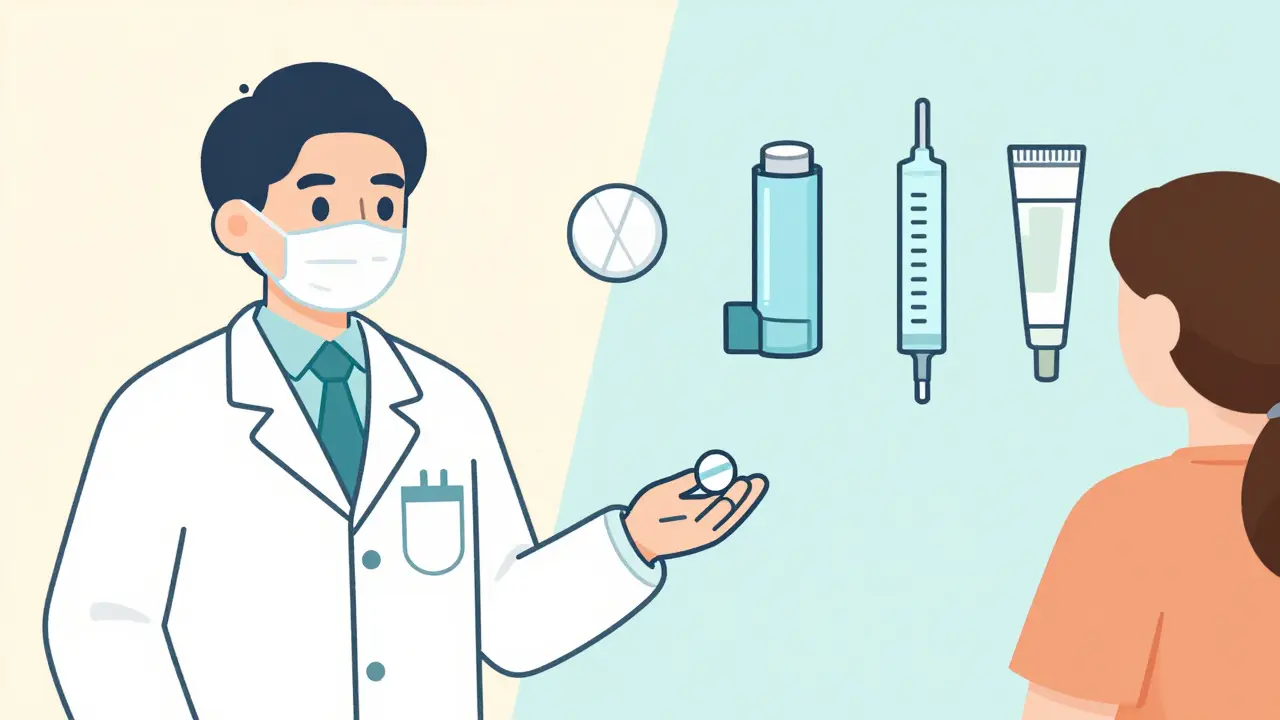
When you pick up a generic pill at the pharmacy, you expect it to work just like the brand-name version. That’s the promise of generic drugs: same active ingredient, same effect, lower price. But what if the drug isn’t just a simple tablet? What if it’s an inhaler that delivers medicine deep into your lungs, a cream that needs to penetrate your skin, or a liposome-based injection that behaves nothing like a standard pill? These are complex generic formulations, and proving they’re bioequivalent to the brand-name drug isn’t just harder-it’s often a scientific marathon with no guarantee of success.
What Makes a Generic Drug "Complex"?
The term "complex generic" isn’t marketing jargon-it’s a regulatory classification. The FDA defines these as products where the usual methods for proving bioequivalence simply don’t work. They fall into five main buckets:
- Drugs with tricky active ingredients-like peptides, natural extracts, or large polymer molecules
- Formulations that aren’t simple solutions-think liposomes, nanoparticles, gels, emulsions, or suspensions
- Products that deliver medicine locally-not systemically-like eye drops, nasal sprays, or topical creams
- Advanced dosage forms-extended-release injectables, metered-dose inhalers, transdermal patches
- Drug-device combos-like auto-injectors or nebulizers where the device is part of the drug’s performance
These aren’t rare oddities. There are about 400 such branded drugs on the U.S. market right now with no generic alternative. Why? Because proving they work the same way is incredibly difficult. While over 80% of simple generics get approved, only 10-15% of complex ones make it through.
Why Blood Tests Don’t Work for Complex Drugs
For most pills, bioequivalence is proven with a simple blood test. You give volunteers the brand-name drug and the generic, then measure how much of the active ingredient shows up in their bloodstream over time. The key numbers? AUC (total exposure) and Cmax (peak concentration). If the generic’s values fall within 80-125% of the brand’s, it’s considered bioequivalent.
But that method breaks down for drugs that don’t enter the bloodstream. Take a corticosteroid cream for eczema. The drug isn’t meant to be absorbed into your blood-it’s meant to sit on your skin and calm inflammation. Measuring blood levels tells you nothing about whether the generic cream penetrates the skin the same way. Same with inhaled asthma medications. The drug needs to land in the right part of your lungs. Blood tests won’t tell you if the particle size, spray pattern, or inhalation timing is right.
That’s the core problem: traditional bioequivalence studies measure what happens after absorption. Complex generics are designed to act before absorption-even before they enter the bloodstream.
The Reverse-Engineering Nightmare
Generic manufacturers don’t get the recipe. They don’t know the exact ratios of excipients, the precise manufacturing temperature, or how the brand-name company controls particle size. They have to reverse-engineer it-essentially tasting the dish without knowing the ingredients.
This process, called "de-formulation," is like solving a puzzle with half the pieces missing. One tiny change-say, swapping one type of emulsifier in a cream-can alter how the drug penetrates the skin. A 5% shift in particle size in an inhaler can mean the difference between the medicine reaching the lungs or getting stuck in the throat.
And it’s not just the active ingredient. Inactive ingredients-fillers, stabilizers, preservatives-can drastically affect stability, dissolution, and even how the body responds. A generic cream might look identical, but if the pH is off by 0.2 units, it could fail to penetrate the skin barrier. These aren’t "fillers"-they’re critical to performance.

Stability: The Silent Killer
Complex formulations are fragile. Liposomes can break down. Nanoparticles can clump. Emulsions can separate. Temperature, humidity, and even light exposure during shipping or storage can change the product’s behavior.
For a traditional tablet, stability is relatively predictable. For a topical gel with multiple polymers and surfactants? Not so much. A batch might pass initial tests but degrade over time, changing how the drug releases. That means a generic that works today might not work in six months.
Regulators now demand accelerated and real-time stability studies covering the entire shelf life. That adds months-and hundreds of thousands of dollars-to development time. And if the product degrades differently than the brand, bioequivalence is out the window.
Regulatory Maze: No Global Standard
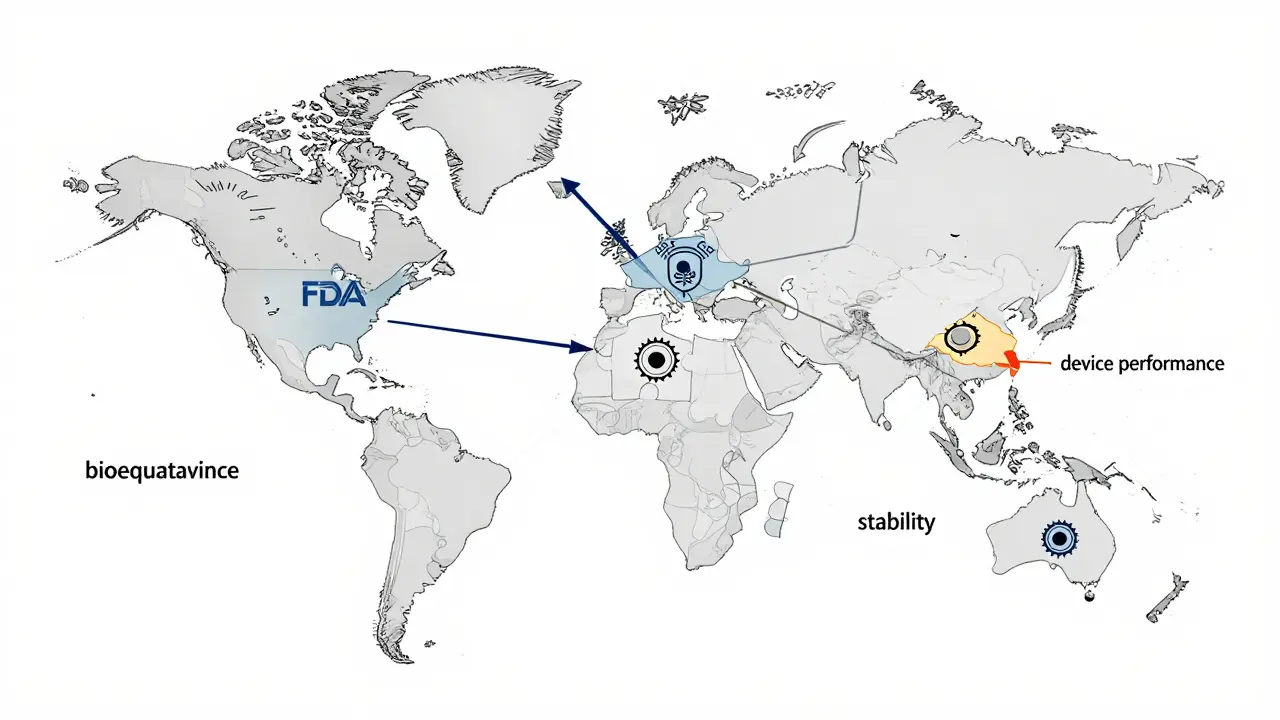
Even if you solve the science, you still have to navigate a patchwork of global rules. The FDA might accept a certain in vitro test for a topical product. The European Medicines Agency (EMA) might demand a completely different approach. One country wants clinical endpoint data. Another says in vitro data is enough.
This forces manufacturers to run duplicate studies-first for the U.S., then for Europe, then for other markets. Each one costs millions. It’s why many companies give up. A 2020 survey found that 89% of generic developers listed bioequivalence testing as their top challenge. Another 76% said stability testing was a nightmare.
Real-World Costs and Failures
Developing a complex generic isn’t just expensive-it’s risky. On average, it takes 18-24 months longer than a simple generic. Development costs are 2.5 to 3 times higher. And failure rates? Over 70% at the bioequivalence stage.
One company spent five years and $40 million developing a generic version of a complex inhaled steroid. They passed all lab tests. But when they ran the human study, the lung deposition was 18% lower than the brand. The product failed. No second chances. No refunds.
Compare that to a simple generic like metformin. It’s been made by dozens of companies for decades. The bioequivalence study? One week. One hundred volunteers. One blood test. Cost: under $200,000.
How the FDA Is Trying to Fix This
The FDA knows the problem. That’s why they created the Complex Generic Drug Products Committee and started publishing new guidance documents-15 in just two years. They’re pushing for Quality by Design (QbD), which means building stability and bioequivalence into the formulation from day one, not testing for it at the end.
They’re also investing in new tools:
- Imaging tech to track how creams penetrate skin layers
- Machine learning models to predict aerosol behavior in inhalers
- Physiologically-based pharmacokinetic (PBPK) modeling to simulate drug behavior without human trials
PBPK modeling is a game-changer. It can reduce the need for human bioequivalence studies by up to 60% for some products. Instead of testing on 24 people, you might only need 12-or even none, if the model is validated.
Companies that engage with the FDA early-through the Complex Generic Drug Product program-see approval rates 35% higher than those that don’t. Early feedback saves time, money, and heartbreak.
The Future: More Complex Generics, But Not Soon
The market for complex generics is huge-$120 billion in the U.S. alone. Sales are projected to grow from $15 billion in 2023 to $45 billion by 2028. That’s a 24.6% annual growth rate.
But growth won’t come easy. Even with better tools, the barriers remain high. As Dr. Steven Schwendeman put it: "Even small manufacturing changes can have outsized effects on product performance."
Progress is happening. New analytical methods for liposomes and nanosuspensions were published in 2022-2023. The International Council for Harmonisation (ICH) is working on global standards for elemental impurities in complex formulations, expected to finalize in late 2024.
But until we have standardized, validated methods for every type of complex product-until regulators worldwide agree on what "bioequivalent" really means for a transdermal patch or an inhaler-this market will remain underdeveloped. The science is advancing. The need is urgent. But the path? Still long, expensive, and uncertain.
Why This Matters to Patients
Behind every complex generic that doesn’t make it to market is a patient paying hundreds or even thousands of dollars for a drug that could cost a fraction of that. A brand-name inhaler for COPD? $600 a month. A generic? If it existed, maybe $50. But without proven bioequivalence, regulators can’t approve it.
It’s not just about cost. It’s about access. Patients with chronic conditions-asthma, psoriasis, rheumatoid arthritis-deserve affordable options. But those options can’t be rushed. They can’t be guesswork. They need science. Rigorous, reproducible, validated science.
The challenge isn’t whether complex generics should exist. It’s whether we’re willing to invest in the science to make them real.


Comments
Bobby Collins
They’re hiding something. You think Big Pharma doesn’t own the FDA? They don’t want generics because then people would stop paying $600 for inhalers. The ‘science’? Just a smokescreen. I’ve seen patents get renewed by changing one chemical by 0.1%. They’re laughing all the way to the bank while we choke on prices.
January 3, 2026 AT 03:08
Layla Anna
Wow this is so eye-opening 😅 I never thought about how a cream’s pH could make or break it… like, who knew the ‘inactive’ stuff was actually the MVP? My grandma uses that eczema cream and I always thought it was just ‘chemicals’ but now I get it-every little bit matters. Thanks for explaining it like I’m not a scientist 🙏
January 4, 2026 AT 12:03
Heather Josey
This is a critical issue in public health. The regulatory fragmentation across jurisdictions creates unnecessary barriers to affordable medication access. The FDA’s adoption of Quality by Design and PBPK modeling represents a scientifically rigorous and economically sustainable path forward. We must prioritize investment in these technologies-not only for equity, but for systemic efficiency in pharmaceutical innovation.
January 5, 2026 AT 19:05
Donna Peplinskie
Thank you for writing this-it’s so important to highlight how fragile these formulations are… I’ve worked with patients who switch to generics and then have flare-ups, and no one ever connects it to the formulation… it’s not their fault, it’s the system… we need more transparency, more funding, more patience… and please, let’s stop treating patients like guinea pigs.
January 7, 2026 AT 11:48
Olukayode Oguntulu
De-formulation is merely the epistemological crisis of late-stage capitalist pharmacology. The ontological rupture between the signifier (the pill) and the signified (the therapeutic effect) has been weaponized by technocratic hegemonies. The FDA’s QbD paradigm? A palliative for the commodification of biological intimacy. We are not measuring bioequivalence-we are measuring the collapse of phenomenological trust in the pharmakon.
January 9, 2026 AT 02:38
jaspreet sandhu
People make this sound like rocket science but it’s really just lazy manufacturing. If you can’t copy a cream that works, maybe you shouldn’t be in pharma. Back in India we make generics for everything-even complex ones-and they work fine. You just need to stop overthinking and start testing more. Why do you need 24 people for a study? 10 is enough. And why do you need all these fancy machines? Just use a microscope and a stopwatch. Simple.
January 9, 2026 AT 07:14
Alex Warden
So let me get this straight-we’re letting foreign companies and bureaucrats delay life-saving meds because they can’t be bothered to do basic science? This is why America’s healthcare sucks. We should ban every foreign regulatory standard and make the FDA the final word. If we can land on the moon, we can make a damn inhaler that works. Stop the red tape. Just approve what’s safe.
January 11, 2026 AT 05:51
LIZETH DE PACHECO
Thank you for sharing this. I work with asthma patients every day, and seeing them struggle with cost is heartbreaking. I’m hopeful the FDA’s new tools will help-because no one should choose between breathing and rent.
January 11, 2026 AT 14:01
Lee M
It’s not that the science is hard-it’s that the incentives are broken. Why would anyone spend $40 million and five years on something that might fail? Capitalism doesn’t reward patience, it rewards speed and profit. The system is designed to keep the few rich and the many sick. The real bioequivalence test? Who can afford the drug.
January 11, 2026 AT 15:55
Kristen Russell
This is why we need more public funding for generic R&D. The market won’t fix this.
January 12, 2026 AT 09:30