
Complex Generic Formulations: Why Proving Bioequivalence Is So Hard
- Colin Hurd
- 1 January 2026
- 14 Comments
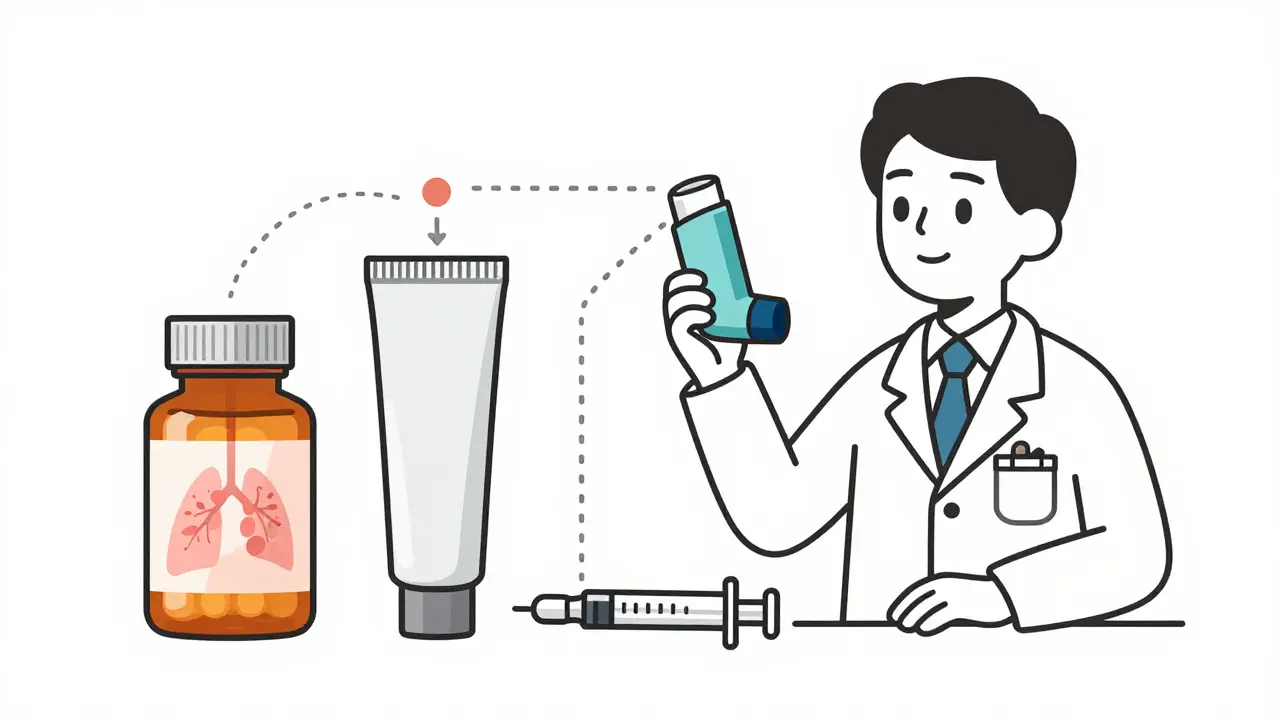
When you pick up a generic pill at the pharmacy, you expect it to work just like the brand-name version. That’s the promise. But what happens when the drug isn’t just a simple tablet? What if it’s an inhaler that delivers medicine deep into your lungs, a cream that needs to penetrate your skin just right, or a long-acting injection that releases drug over weeks? These are complex generic formulations, and proving they’re truly equivalent to the original isn’t just hard-it’s one of the biggest unsolved problems in modern pharmacy.
What Makes a Generic Drug "Complex"?
Not all generics are created equal. The FDA defines complex generics as products where the drug’s delivery system, chemistry, or route of administration makes it nearly impossible to prove equivalence using standard blood tests. These include:- Liposomal drugs (tiny fat bubbles that carry medicine)
- Inhalers like those for asthma or COPD
- Topical creams and gels for eczema or psoriasis
- Transdermal patches that release medicine through the skin
- Injectable suspensions with particles sized between 1-10 micrometers
- Drug-device combos like auto-injectors or nasal sprays
These aren’t niche products. Over 400 such brand-name drugs are on the market in the U.S. alone-and fewer than 15% have generic versions. Why? Because the old rules for proving bioequivalence don’t work here.
The Bioequivalence Problem
For a regular pill, proving bioequivalence is straightforward. You give volunteers the generic and the brand-name drug, measure how much of the drug shows up in their blood over time, and check if the numbers match within strict limits (80-125% for AUC and Cmax). If they do, the FDA says: "Same effect. Approved." But what if the drug isn’t meant to enter the bloodstream at all? Take a steroid cream for eczema. The goal isn’t to get it into your blood-it’s to get it into the top layers of your skin. You can’t measure that with a blood test. Same with an inhaler: you need to know if the drug particles reach the right part of the lung, not how much ends up in the bloodstream.That’s the core problem: bioequivalence is defined by how the drug becomes available at the site of action. But for complex products, we often can’t see or measure that site. So regulators and manufacturers are stuck trying to prove something they can’t directly observe.
Why Reverse-Engineering Is Like Cooking Blind
Generic manufacturers don’t get the original formula. They don’t know the exact type of polymer used in the liposome, the precise spray nozzle design in the inhaler, or the hidden excipients that stabilize the drug. So they have to reverse-engineer it.It’s like being handed a gourmet chocolate cake and told to recreate it-without the recipe, without knowing the oven temperature, and without being able to taste the inside. You can analyze the crust, smell the aroma, and guess the sugar content, but you won’t know if the inside is moist or dry until you bake it. And if it’s too dry, the whole batch fails.
Each small change-using a different surfactant, changing the mixing speed, even the humidity during manufacturing-can alter how the drug behaves. One study found that a 5% shift in particle size distribution in an inhaled product could cut lung deposition by 40%. That’s not a tweak. That’s a different drug.
Stability: The Silent Killer
Complex formulations are fragile. Liposomes break down if they get too warm. Inhaler propellants evaporate if stored wrong. Creams separate if exposed to light. These aren’t theoretical risks-they’re daily manufacturing headaches.One generic maker reported that a batch of a topical gel failed stability testing after just 3 months because a minor change in the emulsifier caused the active ingredient to crystallize. The brand-name version stayed stable for 2 years. The generic? Rejected. And they had no idea why-until they spent six months running 200 different tests.
These aren’t manufacturing errors. They’re scientific blind spots. The brand-name company spent years optimizing their process. The generic maker has to guess what those optimizations were-and then replicate them under tighter cost controls.
Global Regulatory Chaos
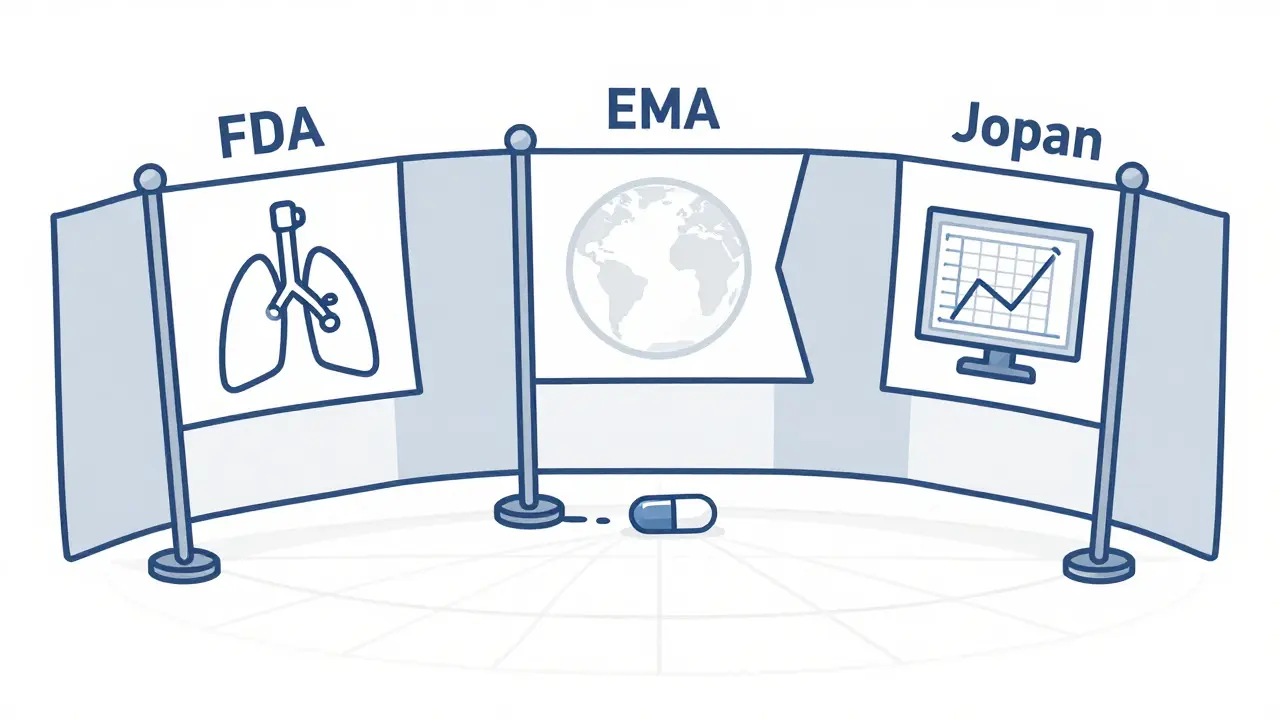
Even if you solve the science, you still have to navigate a maze of conflicting rules. The FDA might accept an in vitro test for an inhaler. The European Medicines Agency (EMA) might demand a clinical endpoint study. Japan might require a different particle size range.One company spent $18 million developing a generic version of a complex injectable. They passed FDA testing. Then they tried for EMA approval-and had to redo half the studies because the European regulators didn’t accept the same analytical method. That’s not efficiency. That’s duplication.
As a result, most companies focus on the U.S. market first. But even there, approval rates for complex generics hover around 10-15%. For simple tablets, it’s over 80%.
What’s Being Done to Fix This?
The FDA isn’t ignoring the problem. They’ve created the Complex Generic Drug Products Committee and published 15 new guidance documents since 2022. These cover everything from topical corticosteroids to testosterone gels.Three major tools are emerging:
- Physiologically-Based Pharmacokinetic (PBPK) Modeling - Instead of testing in people, scientists use computer models to predict how the drug will behave based on its physical properties. Early results show this could cut bioequivalence studies by up to 60%.
- In Vitro Testing - New devices now simulate lung deposition for inhalers or skin penetration for creams. One FDA-approved test mimics how a cream spreads on human skin under pressure.
- Quality by Design (QbD) - Manufacturers are now required to map every step of production and identify which variables matter most. It’s like building a car with a blueprint that shows exactly which bolts affect fuel efficiency.
Companies that engage with the FDA early-before spending millions-have a 35% higher approval rate. That’s not luck. It’s strategy.
The Real Cost of Delay
Every year without a generic, patients pay hundreds or even thousands more for a drug. A single brand-name inhaler can cost $500. A generic version? $50-if it exists. But because of the scientific hurdles, only 1 in 7 complex drugs has a generic alternative.The economic impact is massive. The U.S. market for complex drugs is worth $120 billion. By 2028, generic versions could capture $45 billion of that-if we can solve the bioequivalence problem.
Right now, the biggest barrier isn’t money. It’s knowledge. We don’t have enough standardized tests. We don’t have enough data on how these products behave in real patients. And we don’t have enough scientists trained to work at the intersection of chemistry, physics, and biology that these drugs demand.
What’s Next?
The future of complex generics depends on three things:- Harmonization - Global regulators need to agree on what tests count. The ICH is working on it, but progress is slow.
- Investment - More funding for research into new analytical tools. Right now, most innovation comes from academic labs, not big pharma.
- Transparency - If brand companies shared more non-proprietary data on how their products work, generic makers could build better copies faster.
There’s no magic bullet. But progress is happening. In 2023, the FDA approved the first generic version of a liposomal amphotericin B injection-after 17 years of failed attempts. That’s the breakthrough we need more of.
Complex generics aren’t just harder to make. They’re harder to prove. But the stakes are too high to give up. Millions of people need these drugs. And they deserve the same access to affordable medicine as everyone else.
Why can’t we just use blood tests for complex generics like we do for regular pills?
Blood tests only work when the drug needs to enter the bloodstream. But complex generics like inhalers, creams, or eye drops are designed to act locally-on the skin, lungs, or eyes. Measuring drug levels in the blood tells you nothing about whether the medicine reached the right spot in the right amount. For example, a steroid cream might have zero detectable levels in blood but still be perfectly effective on the skin. That’s why regulators now rely on specialized tests that mimic how the drug behaves at its target site.
How long does it take to develop a complex generic compared to a regular one?
A regular generic takes about 2-3 years to develop. A complex generic? Typically 4-5 years-sometimes longer. That’s because each step takes more time: reverse-engineering the formulation, developing new analytical tests, running stability studies, and negotiating with regulators. Failure rates are also much higher. Over 70% of complex generic applications fail at the bioequivalence stage, compared to less than 20% for simple tablets.
Why are there so few generic versions of inhalers and topical creams?
Because they’re technically and financially risky. Inhalers require precise control over particle size, spray pattern, and delivery timing. Topical products need to penetrate skin layers consistently. Neither can be measured with standard blood tests. Developing tests for these is expensive, and regulators often don’t accept new methods unless they’re proven over time. Most generic companies avoid these products because the cost of failure is too high.
Can computer models replace human trials for complex generics?
Yes, in some cases. Physiologically-Based Pharmacokinetic (PBPK) modeling uses data on a drug’s chemical properties, how it dissolves, and how the body absorbs it to predict performance without testing in people. The FDA now accepts PBPK models for certain complex products like topical corticosteroids and inhaled drugs. For some formulations, this can reduce or even eliminate the need for clinical bioequivalence trials-cutting development time and cost significantly.
What’s the biggest barrier to getting more complex generics on the market?
The biggest barrier is the lack of standardized, accepted testing methods. Every complex product is different, and regulators don’t always agree on what data counts. A test that works for the FDA might be rejected by the EMA. Without global alignment, companies can’t scale development. Until we have universal standards for measuring things like skin penetration or lung deposition, progress will remain slow and expensive.



Comments
Bobby Collins
They’re hiding something. Why else would they make it so hard to copy? Big Pharma owns the FDA. They don’t want generics because they make $500 inhalers. You think this is science? Nah. It’s profit. They’ll keep saying 'we can’t measure it' until you’re paying $400 a month for your asthma meds. I’ve seen it before with insulin. Same story. Always.
January 1, 2026 AT 15:15
Layla Anna
Wow this is so eye-opening 😅 I had no idea how wild it is to make generic creams or inhalers. Like… you’re basically trying to copy a cake without knowing the recipe or tasting it? That’s insane. I’m glad someone’s working on it but also… why does it take 17 years to copy one drug? 😭
January 2, 2026 AT 19:59
Heather Josey
This is a critical issue in global health equity. The regulatory fragmentation between the FDA, EMA, and other agencies creates unnecessary barriers to affordable medicines. The adoption of QbD and PBPK modeling represents a paradigm shift toward science-based regulatory decision-making. We must prioritize international harmonization through ICH to reduce redundant testing and accelerate access. This isn’t just technical-it’s ethical.
January 4, 2026 AT 11:45
Donna Peplinskie
Wow, I never thought about how fragile these formulations are… like, one tiny change in humidity and the whole thing fails? That’s so fragile. And I love that they’re using computer models now-it feels like we’re finally catching up to how complex biology really is. I hope more young scientists get into this field, because we need people who get both the chemistry AND the human side of it.
January 5, 2026 AT 03:41
Olukayode Oguntulu
Ah, the neoliberal pharmakon-capitalist epistemology has colonized the pharmacopeia. The bioequivalence paradigm is a positivist illusion, a fetishization of quantifiable metrics that ignores the ontological multiplicity of pharmaceutical phenomenology. The body is not a beaker. The skin is not a membrane. The lung is not a pipe. And yet, we reduce the sublime art of drug delivery to a fucking chromatogram. Pathetic.
January 6, 2026 AT 02:57
jaspreet sandhu
This whole thing is just a waste of time. Why not just make the same thing? If the brand name works, copy it. Why do you need fancy machines or computer models? In India we make generics for everything and people live. You overthink everything. Just use the same ingredients and same process. If it doesn’t work, then the patient was weak anyway. No need for 15 guidance documents. One rule: copy it.
January 8, 2026 AT 01:23
Alex Warden
USA leads the world in medicine. Why are we letting Europe and Japan dictate how we test drugs? We invented the FDA. We don’t need their approval. Let’s just approve our own generics and stop waiting for foreign bureaucrats to say ‘no’. If they can’t replicate our science, that’s their problem. We’re the health superpower. Stop begging for global consensus.
January 8, 2026 AT 07:26
LIZETH DE PACHECO
This is actually really hopeful. Even though it’s hard, people are figuring it out. The fact that they got a liposomal generic approved after 17 years? That’s huge. It means progress is possible. We just need more funding and more patience. And maybe more people who care about this stuff-not just the big companies.
January 9, 2026 AT 13:04
Lee M
It’s not that we can’t measure it. It’s that we refuse to accept that some things are inherently unquantifiable. The body isn’t a machine. You can’t reduce drug delivery to a number. The real bioequivalence is in the patient’s experience-not in a lab report. We’re trying to force nature into a spreadsheet. That’s the real failure.
January 10, 2026 AT 23:32
Kristen Russell
Finally, someone gets it. We’ve been stuck in the blood-test mindset for decades. Time to move on. PBPK and in vitro models? Yes. Let’s stop wasting lives waiting for approval. This is the future.
January 11, 2026 AT 06:32
sharad vyas
It’s funny how we call it ‘reverse-engineering’ like it’s a crime. We copy everything else-phones, cars, software. But medicine? Oh no, that’s sacred. Maybe if we stopped treating drugs like magic spells and more like tools, we’d get better at making them. No need to worship the brand-name gods.
January 12, 2026 AT 13:40
Dusty Weeks
so like… if the cream doesn’t work but the blood test is fine… is it still a generic? 😅 i just want my eczema to stop itching. why is this so hard??
January 12, 2026 AT 23:10
Sally Denham-Vaughan
Man, I used to think generics were just cheaper pills. Now I realize it’s like trying to rebuild a jet engine with spare parts from a bicycle. The more I learn, the more I respect the people doing this work. Seriously-kudos to the scientists grinding away in labs nobody sees.
January 13, 2026 AT 11:53
Todd Nickel
The real tragedy here isn’t the science-it’s the institutional inertia. Regulatory agencies are structured for simplicity, not complexity. They’re trained to evaluate single-compound, orally absorbed drugs. But modern therapeutics are systems: delivery matrices, device interfaces, environmental sensitivities. We’re applying 1980s regulatory frameworks to 2020s pharmacology. The mismatch isn’t accidental-it’s structural. Until regulators hire more engineers, physicists, and materials scientists-not just pharmacologists-we’re just rearranging deck chairs on the Titanic. The tools exist: PBPK, in vitro skin models, microfluidic aerosol simulators. But the culture hasn’t caught up. And culture, not technology, is the true bottleneck.
January 13, 2026 AT 22:00