
Garlic Supplements and Anticoagulants: What You Need to Know About Bleeding Risk
- Colin Hurd
- 7 February 2026
- 10 Comments
Garlic Supplement Surgery Timing Calculator
When to Stop Garlic Supplements Before Surgery
Based on the article content about garlic supplements and anticoagulants, this calculator helps determine safe timing for discontinuing garlic supplements before medical procedures.
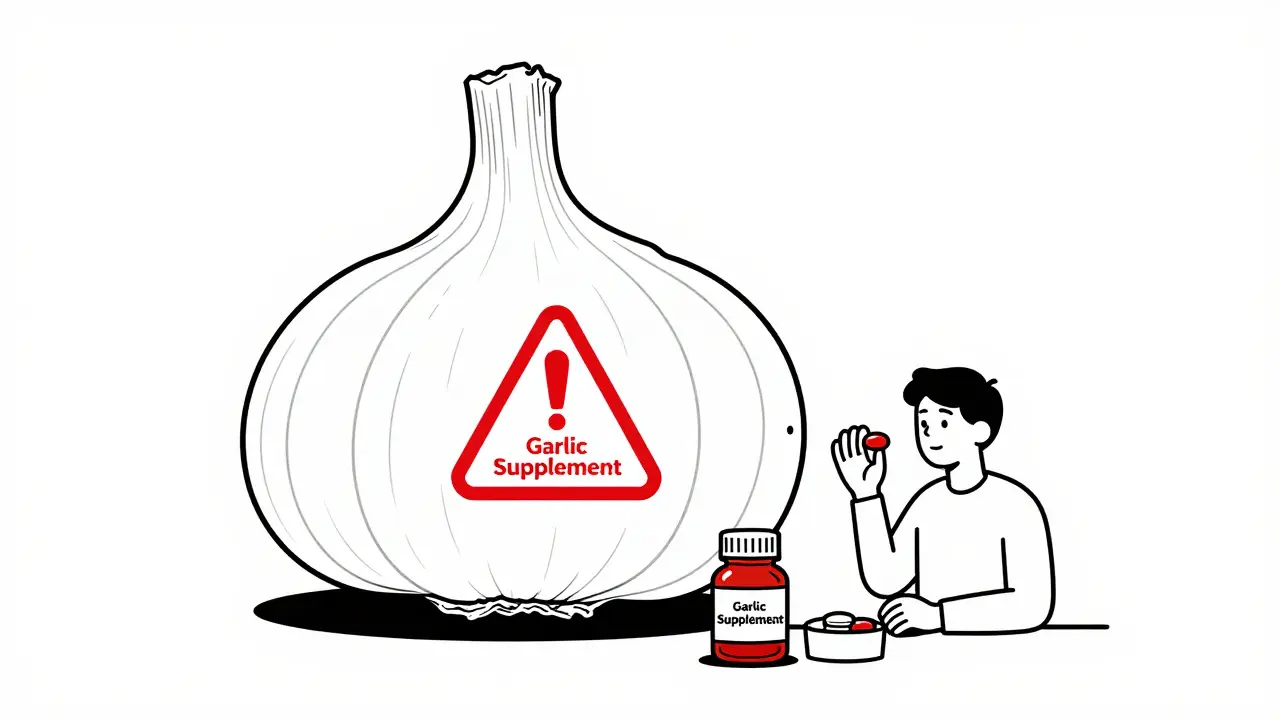
Every year, millions of people take garlic supplements hoping to lower blood pressure, boost immunity, or improve heart health. But if you're on a blood thinner like warfarin, apixaban, or rivaroxaban, that daily garlic pill could be putting you at serious risk. The problem isn't just theoretical - it's documented in hospital operating rooms, emergency departments, and patient stories online. Garlic doesn't just mildly affect blood clotting. It can double your bleeding risk when combined with anticoagulants.
How Garlic Thins Your Blood
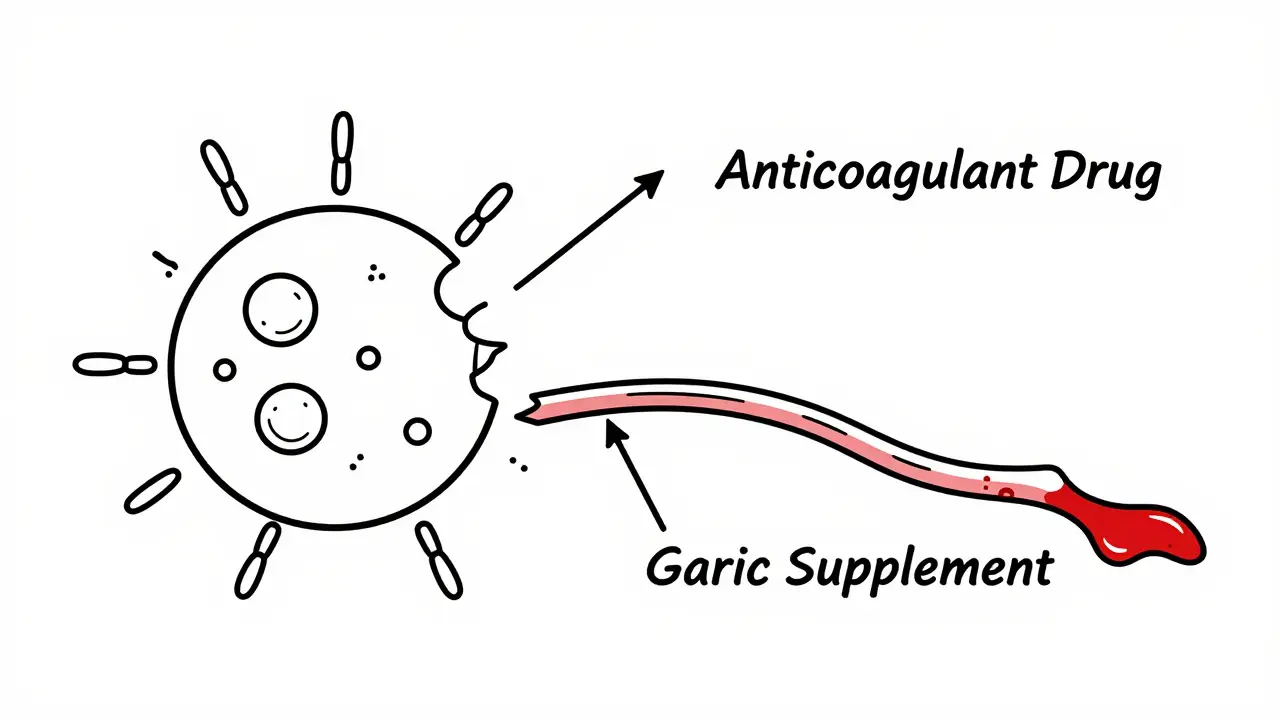
Garlic isn't just a flavoring in your pasta sauce. The active ingredient in supplements - called ajoene - is a sulfur compound that permanently disables platelets, the tiny blood cells that start clots. Once a platelet is blocked by ajoene, it can't function again. Your body has to make new ones, which takes 7 to 10 days. That's longer than aspirin's effect, and unlike aspirin, garlic supplements aren't monitored or controlled by doctors.
Studies show that standard garlic supplement doses - usually 600 to 1,200 mg of dried garlic powder - reduce platelet activity by 20% to 40%. That might sound small, but when you're already on a blood thinner, even a 20% extra effect can push you into dangerous territory. One 1996 trial found that healthy adults taking garlic supplements had platelet function drop sharply within 2 to 4 hours after taking it, and the effect lasted over 72 hours. That means if you take a garlic pill on Monday, your blood is still thinner on Thursday.
Why This Matters with Anticoagulants
Anticoagulants work in different ways. Warfarin slows down clotting proteins, while DOACs like apixaban block specific enzymes. Garlic doesn't interfere with those mechanisms directly. Instead, it attacks the platelets - the first line of defense in stopping bleeding. So when you combine them, you're hitting clotting from two angles: one from the drug, one from the supplement.
The results are real. A 1998 case series in Chest found that patients on warfarin who started garlic supplements saw their INR (a blood test measuring clotting time) jump by 1.0 to 2.5 points. For context: a normal INR is around 1.0. Therapeutic range for someone on warfarin is usually 2.0 to 3.0. If it climbs above 4.0, you're at high risk for spontaneous bleeding - even without injury.
One patient in the study developed a brain hemorrhage after starting garlic. Another had a life-threatening stomach bleed. These aren't rare anomalies. In 2012, two patients undergoing colorectal surgery bled so badly they needed emergency open surgery. Both had been taking garlic supplements daily and didn't think it mattered.
Not All Garlic Supplements Are the Same
Not every garlic product has the same effect. The amount of ajoene - the bleeding-causing compound - varies wildly depending on how it's made.
- Oil macerates: Highest ajoene (0.5-1.0 mg/g). Most dangerous.
- Dried powdered garlic: Common in pills. Contains 0.1-0.3 mg/g ajoene. Still risky.
- Aged garlic extract (like Kyolic): Almost no ajoene. May be safer, but not risk-free.
Most supplements don't list ajoene content on the label. The FDA has warned about this since 2021 - potency can vary by up to 15 times between brands. You could be taking a pill labeled "1,000 mg garlic" that has 10 times more active compound than another. No one knows what's inside except the manufacturer.
Real Cases, Real Consequences
The evidence isn't just in journals. It's on Reddit, in ER reports, and in surgery logs.
In March 2023, a user on r/anticoagulants wrote: "I took 900 mg of garlic daily with apixaban. One morning, I had nosebleeds lasting over 30 minutes. I went to the ER. They said it was the garlic."
In 2019, an elderly man developed a spinal epidural hematoma - a blood clot pressing on his spine - after taking 2,400 mg of garlic daily. He needed emergency surgery to avoid paralysis.
Even dental work can become dangerous. A 2001 case report in Urology described a man who bled for four hours after a routine prostate procedure. He'd been taking garlic supplements for "heart health" and didn't tell his doctor.
And here's the scary part: a 2022 survey found 83% of garlic supplement users had no idea it could interact with blood thinners. Two-thirds never talked to their doctor about it.
Who's at Highest Risk?
It's not just older adults. But they're the most vulnerable.
According to the 2022 National Health Interview Survey, 18.3% of Americans over 65 take garlic supplements. Of those, 22.7% are also on anticoagulants. That’s over 3 million people in the U.S. alone - and likely many more worldwide.
High-risk situations include:
- Any surgery - even minor ones like cataract removal or colonoscopy
- Dental extractions or gum surgery
- Neurosurgery (risk of brain bleeding)
- Prostate or pelvic procedures
- Accidental falls or trauma
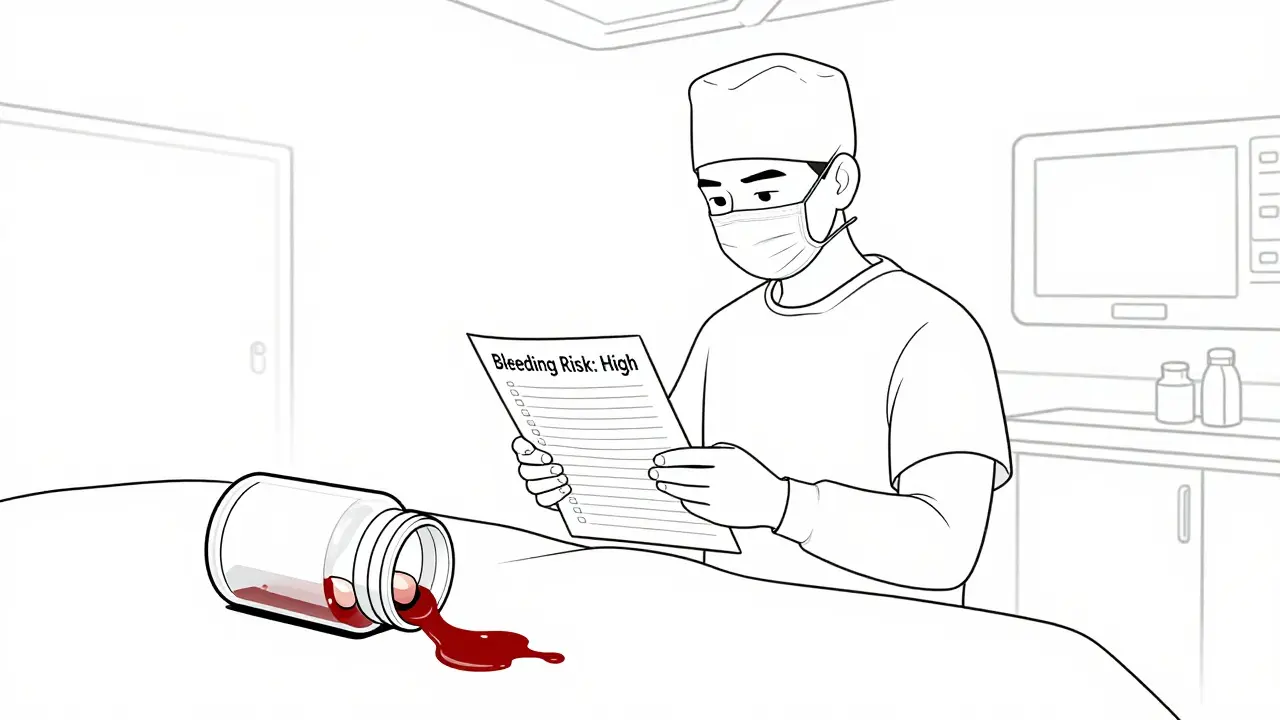
These aren't "maybe" risks. They're documented dangers. The American Society of Anesthesiologists classifies garlic as a "high-risk herbal product" and recommends stopping it 14 days before any surgery. The European Society of Anaesthesiology says 7 days - but both agree: don't take it close to procedures.
What Should You Do?
If you're on a blood thinner:
- Stop garlic supplements immediately. Even if you feel fine, the risk is real.
- Talk to your doctor. Don't assume they know you're taking it. Many patients don't mention supplements unless asked directly.
- Ask about alternatives. If you're taking garlic for blood pressure, ask if diet changes, exercise, or prescribed meds might be safer.
- Check labels. If you must use garlic, choose aged garlic extract - but still avoid it if you're on anticoagulants.
- Wait 7 to 14 days. Don't restart garlic until your doctor says it's safe. Platelet recovery takes time.
And if you're not on anticoagulants yet - but thinking about starting - skip garlic supplements entirely. The risks outweigh the benefits. Studies show garlic lowers blood pressure by only about 7-8 mmHg. That's less than many lifestyle changes. And it's not worth the chance of internal bleeding.
What's Changing?
The tide is turning. In 2023, the FDA proposed new rules requiring garlic supplements to list ajoene content on the label. If finalized in 2024, this could finally force transparency. Some companies, like Kyolic, are already making "ajoene-free" extracts.
Meanwhile, the NIH is funding a $2.4 million study to measure exactly how much garlic increases bleeding risk with DOACs like apixaban. Results are expected by late 2024.
But until then, the message is clear: if you're on a blood thinner, garlic supplements aren't harmless. They're a ticking time bomb.
Can I eat garlic in food if I'm on blood thinners?
Yes. Eating garlic in normal amounts as a seasoning - like a clove or two in cooking - is generally safe. The problem is concentrated supplements. You'd need to eat 10-15 cloves of raw garlic daily to reach the same dose as one supplement pill. Most people don’t eat that much. Stick to food. Avoid pills.
How long does garlic stay in my system?
The antiplatelet effect lasts 72 hours after a single dose. But because it permanently disables platelets, your body needs 7 to 10 days to replace them with new ones. That’s why doctors recommend stopping garlic supplements 7-14 days before surgery - to give your blood time to return to normal clotting function.
Are there any garlic supplements that are safe with blood thinners?
No supplement is proven completely safe. Aged garlic extract (like Kyolic) has much less ajoene and may pose lower risk - but it’s not zero. Independent studies haven't confirmed safety. Until standardized labeling is required, assume all garlic supplements are risky if you're on anticoagulants.
I’ve been taking garlic supplements for years. Should I get my blood tested?
If you're on warfarin, yes. Get your INR checked immediately after stopping garlic. If you're on a DOAC like apixaban, there's no direct test, but watch for signs of bleeding: unexplained bruising, nosebleeds, blood in urine or stool, headaches, or dizziness. If any of these happen, see a doctor right away.
Why don’t doctors always warn patients about this?
Many don’t ask. Patients rarely volunteer that they’re taking supplements. A 2020 study found that doctors who asked specifically about "garlic pills, garlic oil, or garlic extract" got 5 times more honest answers than those who just asked about "herbs." Always bring up supplements yourself. Don’t wait for them to ask.
If you're on anticoagulants, your health isn't about taking more supplements - it's about avoiding hidden dangers. Garlic may be natural, but that doesn't mean it's safe. When it comes to blood thinners, ignorance isn't bliss - it's life-threatening.
Comments
Patrick Jarillon
Let me guess - this is just another Big Pharma scare tactic to keep you hooked on expensive drugs while they bury the truth about garlic. You know what they say: 'Natural remedies are dangerous' - until they patent them. Garlic has been used for thousands of years. The fact that it 'doubles bleeding risk'? That’s a 1996 study on healthy adults, not people on anticoagulants. They didn’t even control for diet. I’ve been taking 1200mg daily for 8 years with zero issues. My INR’s stable. My surgeon didn’t blink when I told him. This whole post smells like a pharmaceutical-funded propaganda piece. They’re scared because garlic costs $5 and works better than warfarin anyway.
February 7, 2026 AT 07:11
Ritu Singh
While I appreciate the clinical rigor of this article, I must respectfully offer a cultural perspective. In India, garlic is not merely a supplement - it is a sacred daily ritual, often consumed raw with salt and lemon at dawn. Millions of diabetics and hypertensives consume it without anticoagulants, and yet, hemorrhagic events remain statistically rare. Perhaps the issue lies not in garlic, but in the cumulative burden of polypharmacy. We must ask: Is it the garlic, or the interaction between three, four, five medications - each with their own cascade of side effects? The West’s obsession with isolating single compounds ignores the holistic wisdom of Ayurveda, where balance, not elimination, is the goal. I urge clinicians to consider context before issuing blanket warnings.
February 8, 2026 AT 12:20
Mark Harris
Bro this is wild. I just stopped my garlic pills after reading this - like, yesterday. I was taking them for 'heart health' and didn’t even think twice. Now I’m like… why did I think a pill was better than just eating garlic in my stir fry? Also, I just told my mom she’s been taking garlic + blood thinner for 5 years. She’s freaking out. Thanks for the wake-up call. This should be on every pharmacy shelf next to the warfarin.
February 9, 2026 AT 17:27
Savannah Edwards
I’ve been reading through this and I just want to say how deeply emotional this whole topic is for me. I lost my uncle to a spontaneous brain bleed last year. He was 71, took garlic supplements religiously because his friend said it 'cleansed the arteries.' He never told his cardiologist. He thought supplements were 'natural' so they were safe. I spent weeks in the hospital with him, watching him slip away, and the doctors kept saying 'we don’t know why it happened.' But we knew. We knew. And now I’m terrified for my own mom, who’s on rivaroxaban and still buys garlic pills every month because the label says 'supports immune function.' I don’t want anyone else to go through this. Please, if you’re on a blood thinner - just stop. Even if you feel fine. The damage is silent. It doesn’t hurt until it’s too late.
February 10, 2026 AT 12:50
Mayank Dobhal
Garlic pills = dumb. Stop.
February 11, 2026 AT 20:45
Marcus Jackson
That 1996 study? It used oil macerates - not the powdered pills most people take. The ajoene content in those is 10x higher than in standard supplements. And the 2012 surgical cases? Both were on warfarin AND took massive doses - 2,400mg daily. Most people take 600mg. There’s a difference between 'risky' and 'common.' Also, the FDA’s warning? It’s a draft. Not law. Don’t panic. Just be smart. If you’re on DOACs, the risk is way lower than with warfarin. And if you’re not having bleeding episodes? You’re probably fine.
February 13, 2026 AT 14:29
Natasha Bhala
i just stopped my garlic pills after this 😭 i had no idea. i thought it was like vitamin c. thanks for sharing this. i love garlic but not enough to risk a stroke. peace out supplements.
February 14, 2026 AT 07:31
Gouris Patnaik
How ironic that Americans, who have turned every herb into a profit-driven pill, now panic over its side effects. In India, we have used garlic for millennia - not as a drug, but as food. The real problem is not garlic - it is the Western medical system’s obsession with quantifying nature into dosage units. You cannot reduce a 5,000-year-old tradition to a 1996 trial. This article reads like fearmongering from a culture that distrusts its own roots. If you want safety, stop taking pills. Eat garlic. Cook with it. Let your body metabolize it naturally - not in a lab-made capsule with undisclosed ajoene levels.
February 15, 2026 AT 06:39
Ashley Hutchins
I can’t believe people are still taking these pills. You know what else is 'natural'? arsenic. Poison doesn’t care if it’s from a plant or a lab. You’re not 'being healthy' - you’re being reckless. And don’t even get me started on the people who say 'my doctor didn’t warn me' - if you’re not telling your doctor about every supplement you take, you’re not a patient - you’re a liability. If you’re on blood thinners and you’re still taking garlic, you’re one fall away from a coffin. And if you think you’re immune because you 'feel fine' - you’re already dead. You just don’t know it yet.
February 16, 2026 AT 02:03
Heather Burrows
It’s funny how we treat supplements like they’re harmless. I mean… we live in a world where people think 'organic' means 'safe' and 'natural' means 'no consequences.' But the body doesn’t care if something came from a tree or a test tube. It just reacts. And if you’re on anticoagulants? Your body is already dancing on a razor’s edge. Adding garlic is like putting a second layer of ice under your feet. You don’t need to be a genius to see where this ends. I’m not saying don’t eat garlic. I’m saying: stop pretending pills are medicine. They’re not. They’re just expensive flavoring with invisible side effects. And honestly? We’re all just waiting for someone to die so we’ll finally take this seriously.
February 16, 2026 AT 07:04