
Military Shelf Life Extension Program: What It Shows about Drug Stability
- Colin Hurd
- 25 March 2026
- 11 Comments
Have you ever found a bottle of pills in the back of your cupboard that expired last year and wondered if it was still safe to take? You aren't alone. Most of us toss out expired medicine without a second thought, assuming it's useless or dangerous. But what if I told you that the U.S. military has been keeping and using drugs years past their printed expiration dates without issue? It sounds risky, but there is a massive federal program behind this practice called the Shelf-Life Extension Program (SLEP). This program doesn't just save money; it fundamentally challenges what we know about how long medicines last.
Understanding the Shelf-Life Extension Program is a federal, fee-for-service program established in 1986 through which the labeled shelf life of certain federally stockpiled medical materiel can be extended after products undergo periodic stability testing conducted by the FDA and administered by the U.S. Department of Defense reveals a lot about the reality of pharmaceutical durability. It turns out that expiration dates on your medicine cabinet aren't necessarily a safety cliff where the drug suddenly turns into poison. Instead, they are often conservative estimates based on limited testing.
How the Military Extends Medicine Lifespans
The SLEP isn't a guesswork operation. It relies on rigorous science. When the Department of Defense (DoD) and the Food and Drug Administration (FDA) started this program in 1986, they noticed something strange. Drugs stored in federal stockpiles were staying stable long after the manufacturer said they should be thrown away. Instead of replacing billions of dollars in inventory, they started testing the actual potency of the drugs in storage.
Here is how the process works in practice. The program operates under DoD Manual 4140.27 Volume 1 is the official regulation governing the management of shelf-life items within the Department of Defense, categorizing them into Type I (non-extendible) and Type II (extendible). Items eligible for extension are classified as Type II. These items undergo periodic stability testing. The FDA's Office of Inspections and Investigations manages the laboratory work, while the Center for Drug Evaluation and Research analyzes the data.
The key metric here is potency. For a drug to get an extension, it must maintain at least 85% of its original strength. If a medication starts at 100% potency, it can degrade down to 85% and still be considered effective and safe for use. This threshold is the same one the FDA uses for approving new drugs. If a batch passes this test, the expiration date gets pushed back, sometimes by several years at a time.
What the Data Says About Drug Stability
The numbers coming out of SLEP are hard to ignore. A 2006 study published in the Journal of Pharmaceutical Sciences looked at 122 different drug products. The result? 88% of them remained stable well beyond their expiration dates. Some of these drugs maintained their potency for more than 15 years past the printed date. This data suggests that the standard two-to-three-year shelf life printed on most commercial bottles is a business decision, not necessarily a hard scientific limit.
The financial impact is massive too. According to the Government Accountability Office, SLEP has extended the shelf life of approximately 2,500 different drug products. Between 2005 and 2015 alone, the program saved the federal government an estimated $2.1 billion. That is money that didn't need to be spent on buying new stockpiles because the old ones were still good.
Consider the Strategic National Stockpile is a national repository of medically established quantities of U.S. Food and Drug Administration (FDA)-licensed and approved drugs, vaccines, biological products, medical devices, and other supplies to respond to a public health emergency. This stockpile relies heavily on SLEP. In 2019, the shelf life of oseltamivir (Tamiflu) was extended by 3 years. This preserved 22 million treatment courses. Without this program, those doses would have been wasted, leaving fewer resources available if a flu pandemic struck.
Commercial vs. Military Dating Practices
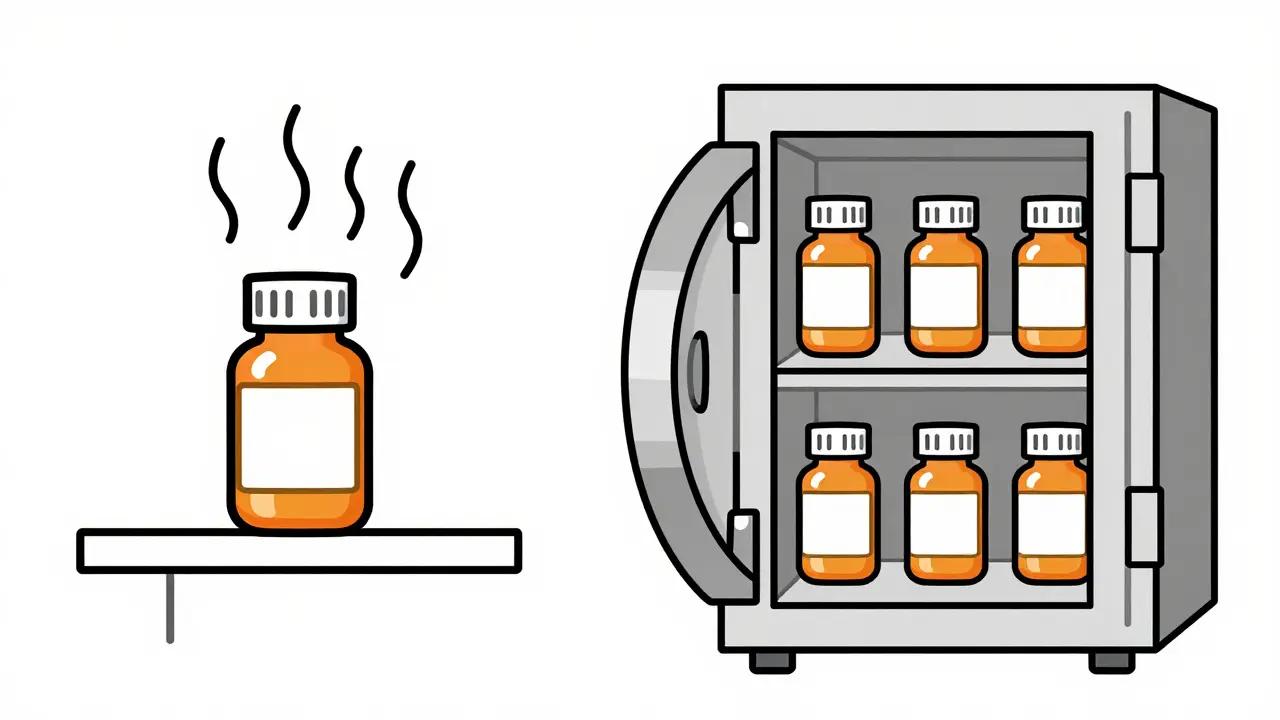
Why doesn't your local pharmacy use the same logic? There is a big difference between a controlled military warehouse and a medicine cabinet in a humid bathroom. Commercial expiration dating is designed for the worst-case scenario. Manufacturers test stability under ideal conditions, but they have to account for how consumers might store the product. If a patient leaves a bottle in a hot car or a damp bathroom, the drug might degrade faster.
Commercial products are typically discarded at expiration regardless of actual stability. A 2019 Health Affairs analysis noted that this practice generates approximately $1.7 billion in annual waste. In contrast, SLEP testing protocols are more rigorous than standard commercial practices. They involve periodic stability testing under strictly controlled conditions. The military knows exactly where every bottle is stored and monitors the temperature and humidity constantly.
| Feature | Commercial Practice | Military SLEP |
|---|---|---|
| Expiration Basis | Conservative estimate (2-3 years) | Actual stability testing |
| Storage Conditions | Uncontrolled (home storage) | Strictly controlled (MQCSS) |
| Extension Process | None (discarded at date) | Periodic FDA testing |
| Success Rate | N/A | 92% of tested lots extended |
Why You Shouldn't Just Copy the Military
It is tempting to look at these savings and think, "I should just keep my expired antibiotics." That is a dangerous idea. Dr. Michael D. Swartzburg, a pharmaceutical stability expert, cautions that SLEP's findings shouldn't be generalized to all drugs or all storage conditions. The program specifically tests properly stored military stockpiles under controlled conditions. The FDA's 2021 guidance document explicitly states that shelf-life extensions under SLEP are specific to the lot numbers, storage conditions, and packaging identified in the extension determination.
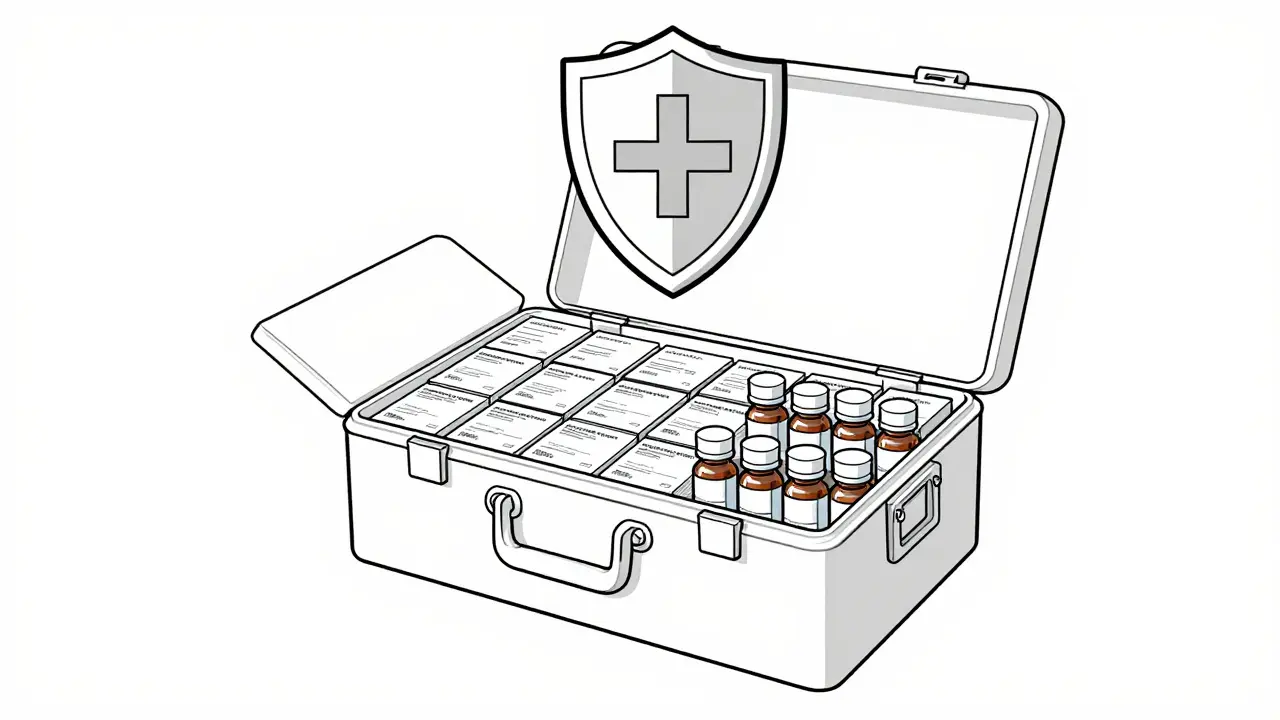
There are critical differences in storage. Military stockpiles follow Materiel Quality Control Storage Standards (MQCSS). This means temperature is kept constant, humidity is regulated, and light exposure is minimized. Your home environment varies wildly. A summer heatwave can ruin a bottle of pills in weeks. The SLEP database, known as the Shelf Life Extension System (SLES), tracks these specific conditions for every batch. You don't have that data for your personal stash.
Also, not all drugs are created equal. Some medications degrade into harmful byproducts. Others lose potency so quickly that they become ineffective. Liquid antibiotics, insulin, and nitroglycerin are examples of drugs that are notoriously unstable. Even if a pill looks fine, the chemical structure might have changed in ways you can't see. SLEP focuses primarily on FDA-approved prescription drug products, and even then, biologicals were only expanded into the program in 2021.
The Role of the FDA and DoD
The relationship between the FDA and the Department of Defense is central to this program. The FDA's Office of Inspections and Investigations (OII) Field Science Laboratories centrally manage the program. They coordinate the laboratory work to ensure accuracy. Dr. Joanne Lesigues, Director of the FDA's Office of Inspections and Investigations, stated that SLEP represents a scientifically sound approach to managing critical medical stockpiles that balances public health needs with fiscal responsibility.
This isn't just about saving money; it's about readiness. The Strategic National Stockpile needs to be ready for emergencies like pandemics or bioterrorism attacks. If they had to replace all their stock every two years, the logistics would be a nightmare. The DoD Shelf Life Extension System (SLES) serves as the central repository for the Quality Status List (QSL). This system allows authorized personnel to check the status of specific lots. Access to SLES requires registration through the Account Management and Provisioning System (AMPS), ensuring that only trained individuals can view the data.
Recent Developments and Future Outlook
The program continues to evolve. In 2021, the PREPARE Act expanded SLEP to include certain biological products. These remain a small percentage of total extended products, but it shows the system is adapting. In December 2022, the FDA and DoD implemented a new electronic data sharing system. This reduced the average shelf-life extension determination time from 14.3 months to 8.1 months. Faster processing means the stockpile stays fresher and more reliable.
Looking ahead, the FDA's 2022-2026 Strategic Plan for Medical Countermeasures identifies expanding the scientific basis for shelf-life extension of critical products as a priority. They plan to incorporate advanced analytical techniques like mass spectrometry and accelerated stability testing. However, there are challenges. A 2023 Congressional Budget Office report estimates that full implementation of proposed SLEP expansions would require an additional $75 million in annual funding. The program faces ongoing challenges with emerging threats requiring new medical countermeasures that may have different stability profiles.
Despite the costs, the value is clear. The Department of Defense reported in its 2021 Annual SLEP Report that 92% of tested lots received shelf-life extensions averaging 2.8 years per extension cycle. This efficiency allows the government to maintain a robust supply of life-saving drugs without constant, expensive replenishment. It proves that with the right testing and storage, drugs are far more durable than we are told.
Key Takeaways for Consumers
So, what does this mean for you? It means expiration dates are not magic deadlines. They are guarantees of potency under ideal conditions. If you have a pill that expired last month and was stored in a cool, dry place, it is likely still effective. However, "likely" isn't good enough when your health is on the line. The military can afford the risk of testing; you can't afford the risk of treatment failure.
Use the SLEP data as a learning tool, not a license to hoard expired meds. If you find yourself in a survival situation where you have no other option, knowing that many drugs remain stable for years can be comforting. But for daily use, stick to the label. The safety margin provided by commercial dating is there for a reason. It accounts for the chaos of real life, which the military doesn't have to worry about in its climate-controlled vaults.
Can I take expired medication at home?
It is generally not recommended. While the SLEP shows many drugs remain stable, this is under controlled storage conditions. Home storage varies, and you cannot verify the specific stability of your lot.
Why does the military keep expired drugs?
The military uses the Shelf-Life Extension Program (SLEP) to test drugs for potency. If a drug maintains 85% potency, it is safe to use and extends the shelf life, saving billions in replacement costs.
What is the FDA's role in SLEP?
The FDA conducts the stability testing and analyzes the data. The Center for Drug Evaluation and Research makes the final decision on whether a drug's shelf life can be extended based on potency results.
How much money has SLEP saved?
The Government Accountability Office documented that SLEP saved the federal government an estimated $2.1 billion between 2005 and 2015 by extending the life of over 2,500 drug products.
Are all drugs eligible for extension?
No. Only Type II items are eligible. Biologicals were only added in 2021. Many drugs are classified as Type I (non-extendible) and must be discarded at their original expiration date.

Comments
Stephen Alabi
The assertion that commercial dating is merely business is a gross oversimplification of regulatory liability. Manufacturers must account for unpredictable consumer storage environments. The military operates under strictly controlled conditions that are not replicable at home. One cannot generalize federal protocols to personal medicine cabinets without risk.
March 27, 2026 AT 08:45
Agbogla Bischof
Indeed. The stability data is robust. However. One must consider the degradation byproducts. These can form in specific chemical structures. Testing ensures potency remains above eighty-five percent. It is a scientific process. Not a guess.
March 27, 2026 AT 09:10
peter vencken
i used to keep my old ibuprofen but my mom made me throw it out. kinda wasteful imo. i guess the military knows better than us regular folks. maybe we should just trust the science more.
March 29, 2026 AT 01:52
Kevin Siewe
It is understandable to feel frustrated by the waste. Safety remains the priority though. We should follow the guidelines for our own health.
March 30, 2026 AT 14:12
Katie Putbrese
Our military knows best. Americans should trust the government stockpile more than foreign pharmacies. It shows our strength and preparedness. We should be proud of this program.
April 1, 2026 AT 09:43
Raphael Schwartz
Never take expiered meds at home.
April 1, 2026 AT 23:43
Jefferson Moratin
Time decays matter. The label is a pact between manufacturer and consumer. We often ignore the passage of time in our storage habits. Stability is a relative concept in chemistry.
April 3, 2026 AT 22:53
Grace Kusta Nasralla
The expiration is a metaphor for our own mortality. We fear the unknown decay within. It is a psychological barrier we must overcome. Trust is the only thing that remains.
April 5, 2026 AT 19:12
Mihir Patel
This is so crazy. I found a bottle from 2010 and i was scart to take it. now i feel dumb. why did i threww it away. it could have been good.
April 7, 2026 AT 15:52
Kevin Y.
That is quite a relief to hear. We should all be more informed. It is good to see the data supporting this.
April 8, 2026 AT 19:27
Caroline Bonner
It really makes you think about how we waste resources every single day... I mean, imagine all the money that gets thrown away just because of a date on a box. The military has been doing this for decades and it works perfectly fine. They test everything thoroughly before they say it is good to use. Why can't we just apply the same logic to our own homes. It is not like the drugs turn into poison overnight. The chemistry stays stable for a long time if kept in the right place. People get so scared of expiration dates without knowing the science behind them. It is just a guarantee of potency under perfect conditions. Most of us do not have perfect conditions in our bathrooms though. Humidity and heat are the real enemies here... Still, the savings are massive and that is something we should care about. We need to stop listening to manufacturers and start looking at the data. The government has proven that these drugs last longer than we think. It is about fiscal responsibility and public health readiness. We should all be more educated on this topic to avoid unnecessary waste. It is a simple concept that gets ignored by the general public constantly. We need to change the way we view medication storage at home. This program shows us that trust is earned through testing not just printed dates. We should all learn from the military approach to inventory management.
April 9, 2026 AT 12:22