
Excipients in Generics: How Inactive Ingredients Affect Tolerance and Side Effects
- Colin Hurd
- 9 December 2025
- 8 Comments
Most people assume that if two pills have the same active ingredient, they work the same way. But what if the problem isn’t the drug itself - it’s what’s around the drug? That’s where excipients come in. These are the so-called "inactive" ingredients in your medication - the fillers, binders, dyes, and preservatives that help the pill hold its shape, dissolve properly, or last longer on the shelf. But "inactive" doesn’t mean harmless. For many people, these ingredients are the real reason they feel sick after switching to a generic version of their medication.
What exactly are excipients?
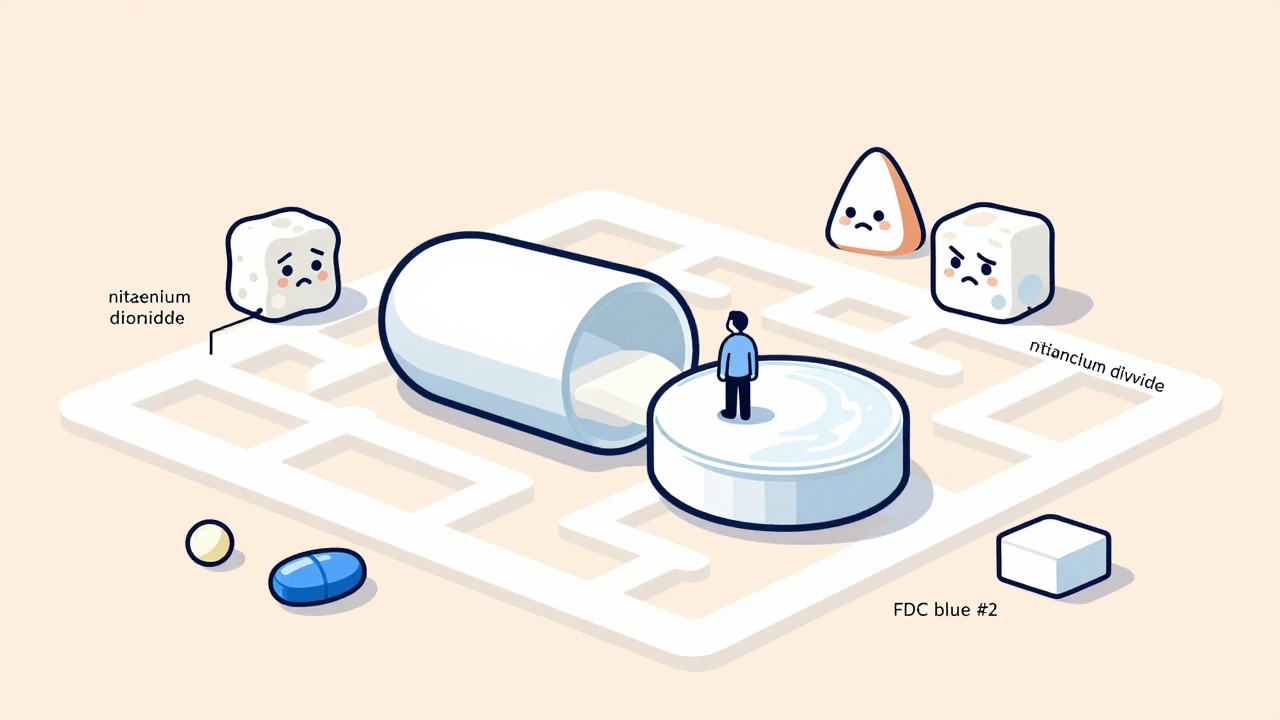
Excipients are substances added to medications that don’t treat your condition but make the drug easier to manufacture, swallow, or absorb. Think of them like the scaffolding around a building - you don’t live in the scaffolding, but without it, the building wouldn’t stand. Common excipients include lactose (a milk sugar), cornstarch, magnesium stearate, titanium dioxide, and artificial colors like FD&C Blue #2 or Yellow #5. In fact, the average oral pill contains about 8.8 excipients, according to a 2019 study that analyzed over 42,000 medications. Some pills have more than 20.
These ingredients serve real purposes. Lactose adds bulk so small doses of medicine can be pressed into tablets. Croscarmellose sodium helps the pill break apart in your stomach. Magnesium stearate keeps the machinery from sticking during production. Preservatives like parabens keep the pill from spoiling. But none of these are meant to affect your body’s chemistry - or so we’ve been told.
Why "inactive" is a misleading term
The word "inactive" is a dangerous misnomer. Just because an ingredient doesn’t target your disease doesn’t mean it’s harmless. Take lactose: it’s in 40-60% of all oral pills. If you’re lactose intolerant, even a small amount - as little as 1-2 grams - can trigger bloating, cramps, nausea, or diarrhea. That’s less than a teaspoon of milk. Many people don’t realize their stomach issues aren’t from food - they’re from their thyroid or blood pressure pill.
Artificial colors are another hidden trigger. FD&C Blue #2 and Yellow #5 have been linked to allergic reactions, headaches, and even behavioral changes in sensitive individuals. One Reddit user switched from brand-name Synthroid to a generic version and suddenly developed severe GI distress. After digging into the ingredients, they found the generic contained Blue #2 - a dye they’d been avoiding for years. Their symptoms vanished the moment they switched back.
Even "natural" excipients can cause trouble. Some people react to cornstarch, gluten (yes, it can be in pills), or even soy-based lubricants. The FDA’s own Inactive Ingredient Database lists 38 excipients with documented links to adverse reactions. And here’s the kicker: these reactions aren’t rare. A 2019 study found that 90.2% of all oral medications contain at least one excipient known to cause intolerance or allergy in some people.
Brand vs. generic: same drug, different ingredients
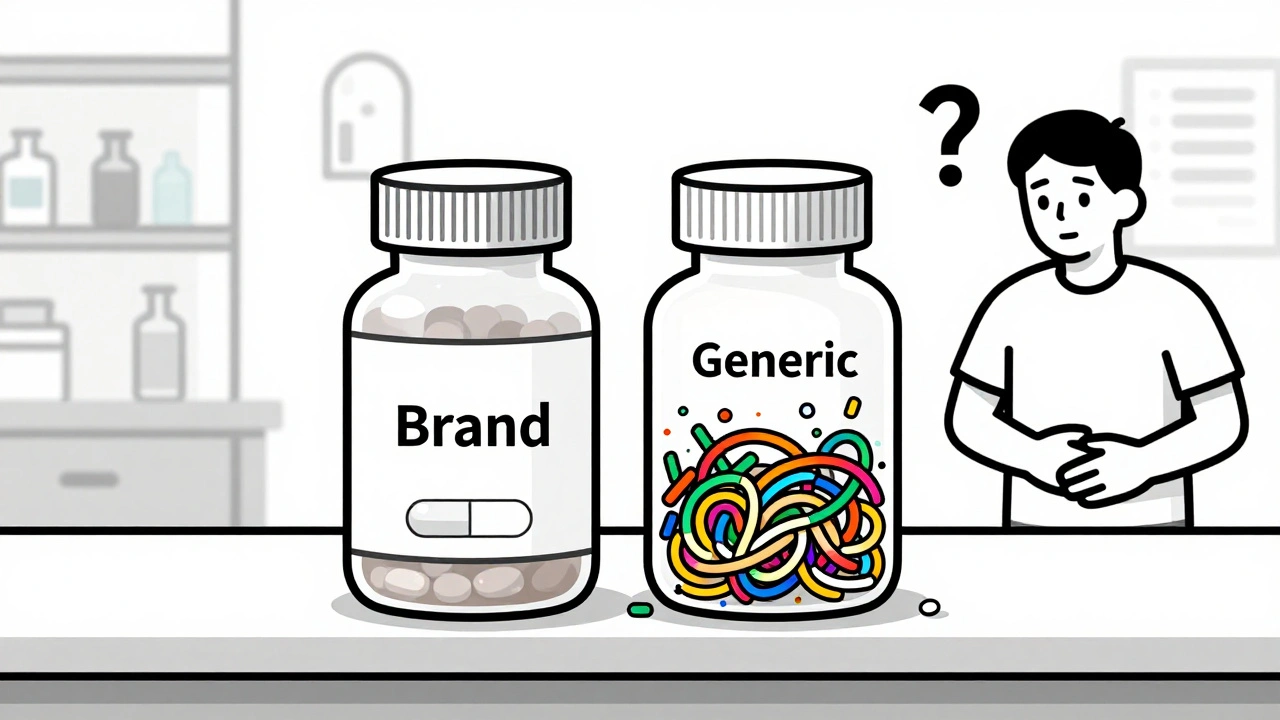
When you switch from a brand-name drug to a generic, the active ingredient stays the same. That’s required by law. But the excipients? They can be completely different. The FDA only requires generics to be bioequivalent - meaning the drug gets absorbed into your bloodstream at roughly the same rate and amount as the brand. That’s it. No rules about what’s in the rest of the pill.
That means two versions of the same generic drug - say, levothyroxine - can have totally different fillers, colors, or coatings. One might use lactose; another might use mannitol. One might have a sugar coating; another might be enteric-coated with a different polymer. For most people, this doesn’t matter. But for those with sensitivities, it’s a gamble.
A 2021 survey of pharmacists found that 73.5% had patients report side effects after switching from brand to generic - and many of those symptoms matched known excipient reactions. One pharmacist in Ohio told me about a patient who kept getting migraines after switching to a generic version of her migraine medication. She had no history of headaches before. After checking the ingredients, they found the new version contained sodium metabisulfite - a preservative she was allergic to. Switching back to the brand version stopped the headaches.
Who’s most at risk?
Not everyone needs to worry. But certain groups are more vulnerable:
- Lactose-intolerant people: Up to 70% of the global population has some level of lactose intolerance. Many don’t even know it - they just think they have "irritable bowel."
- Allergy sufferers: If you react to food dyes, nuts, or gluten, you might react to the same ingredients in pills.
- Children and elderly: Their bodies process excipients differently. Kids are more sensitive to artificial colors. Older adults often take multiple pills, increasing cumulative exposure.
- People with autoimmune or chronic conditions: Those with Crohn’s, celiac, or mast cell activation syndrome often have lower tolerance thresholds.
One study found that 68.3% of independent pharmacists had patients report adverse reactions after switching between generic manufacturers. And these aren’t just "annoyances" - they can lead to non-adherence. If you feel sick every time you take your pill, you’ll skip doses. That’s dangerous for blood pressure meds, thyroid drugs, or antidepressants.
How to find out what’s in your pill
Most pill bottles don’t list all excipients. The label says "active ingredient: levothyroxine 75 mcg," but it won’t tell you if it contains lactose, FD&C Red #40, or titanium dioxide. You have to dig deeper.
Here’s how:
- Check the FDA’s Inactive Ingredient Database - it’s free and updated quarterly. Search by brand name or active ingredient to see approved excipients.
- Use Pillbox (from the National Library of Medicine). Type in the pill’s imprint code (the letters/numbers on it) and it pulls up the full ingredient list.
- Ask your pharmacist. They can contact the manufacturer for the complete formulation. Don’t be shy - this is part of their job.
- Compare brands and generics. If you’re switching, look up both versions side by side. Even small changes matter.
Some pharmacies now offer excipient filters when filling prescriptions. If yours doesn’t, ask them to start. The more people request it, the more likely it becomes standard practice.

What to do if you suspect an excipient reaction
If you notice new symptoms after switching pills - bloating, rash, headaches, fatigue, diarrhea - don’t ignore them. Here’s what to do:
- Track your symptoms. Write down when they started, how bad they are, and what pill you took.
- Check the ingredients. Use Pillbox or ask your pharmacist.
- Don’t stop cold. If it’s a critical medication (like blood pressure or seizure drugs), talk to your doctor before switching.
- Try a different generic. Not all generics use the same excipients. Sometimes switching to another manufacturer fixes it.
- Ask for the brand. If the generic keeps causing issues, your doctor can write "Do Not Substitute" on the prescription. It’s legal, and insurance often covers it if you document the reaction.
Many doctors don’t know to ask about excipients. You might need to bring it up. Say: "I think the problem isn’t the medicine - it’s what’s in the pill." That’s enough to start the conversation.
The future: personalized pills and better labeling
Things are changing. The FDA launched its Excipient Safety Modernization Initiative in 2023 to update safety data based on real patient reports. In 2025, they plan to require full excipient disclosure in electronic prescriptions - meaning your pharmacy system will show you exactly what’s in the pill before you fill it.
Some companies are already ahead of the curve. Specialty generics now come in lactose-free, dye-free, and gluten-free versions. The market for these "sensitive formulation" drugs hit $18.7 billion in 2022 and is growing fast. In Europe, regulators are adding new safety thresholds for excipients. In the U.S., AI tools are being developed to predict your personal tolerance based on your genetics and health history.
For now, the system isn’t perfect. But awareness is rising. More pharmacists are trained to spot these issues. More patients are speaking up. And more manufacturers are responding.
Bottom line: Your pill isn’t just the active ingredient
Generics save money - that’s great. But they’re not always interchangeable. If you’ve had unexplained side effects after switching to a generic, it might not be in your head. It might be in the pill. Lactose. Dye. Preservative. You don’t need to suffer through it. You have the right to know what you’re taking. And you have the right to ask for something better.
Next time you pick up a new prescription, take two minutes to look up the ingredients. It could make all the difference.
Are excipients really harmful?
Excipients are generally safe for most people, but they’re not harmless. For individuals with allergies, intolerances, or sensitivities, certain excipients like lactose, artificial colors, parabens, or sulfites can trigger symptoms ranging from bloating and rashes to headaches and nausea. The FDA has documented 38 excipients linked to adverse reactions. What’s "inactive" for one person can be very active for another.
Can I be allergic to lactose in pills?
Yes. Lactose is in 40-60% of oral medications. Even if you’re mildly lactose intolerant, a single pill can contain 1-2 grams of lactose - enough to trigger symptoms like bloating, cramps, or diarrhea in sensitive people. You don’t need to be severely intolerant to react. Many people don’t realize their stomach issues are from their medication, not their diet.
How do I find out what’s in my generic drug?
Check the FDA’s Inactive Ingredient Database or use the Pillbox tool from the National Library of Medicine. Enter the pill’s imprint code (the letters/numbers on it) to see the full ingredient list. You can also ask your pharmacist to contact the manufacturer - they’re required to provide this info. Brand-name drugs usually list ingredients on the box; generics often don’t.
Why do different generics have different ingredients?
The FDA only requires generics to match the brand in active ingredient strength and absorption rate. There’s no requirement for identical excipients. Each manufacturer chooses its own fillers, binders, and coatings to reduce cost or improve stability. That means two generics of the same drug can have completely different inactive ingredients - and that’s why one might cause side effects while another doesn’t.
What should I do if a generic makes me sick?
Don’t stop taking the medication without talking to your doctor. First, check the ingredients using Pillbox or ask your pharmacist. Try switching to a different generic manufacturer - they may use a different excipient mix. If that doesn’t help, ask your doctor to prescribe the brand-name version with a "Do Not Substitute" note. Insurance often covers it if you document your reaction. Keep a symptom log to show your doctor exactly what happened.
Are there safer generic options available?
Yes. More manufacturers now offer "sensitive formulation" generics that are lactose-free, dye-free, gluten-free, or preservative-free. These are often labeled as such, but you may need to ask. The market for these products is growing fast - over $18 billion in 2022. Your pharmacist can help you find them, or you can search for them online using the FDA’s database.


Comments
Ben Greening
It's fascinating how the pharmaceutical industry treats excipients as an afterthought. The regulatory framework prioritizes bioequivalence over patient-specific tolerances, which is a systemic oversight. Many clinicians are unaware of the extent of excipient variability across generics, and patients are left to self-diagnose. This isn't just about lactose intolerance-it's about a lack of transparency in drug formulation that extends far beyond what's on the label.
December 10, 2025 AT 05:00
Nikki Smellie
They’re hiding this on purpose. 🕵️♀️ The FDA, Big Pharma, and even your pharmacist are complicit. Lactose, titanium dioxide, and FD&C dyes? These aren’t ‘inactive’-they’re slow-acting toxins designed to keep you dependent. Think about it: if everyone knew how many pills contained aluminum-based stabilizers and synthetic binders, the entire system would collapse. The real cure? Raw food, sunlight, and no pills at all. 🌱☀️
December 10, 2025 AT 14:37
David Palmer
bro i switched to a generic thyroid med and started getting headaches like crazy. thought it was stress. turned out it had some weird dye in it. switched back to brand and boom, gone. no joke. this is real.
December 12, 2025 AT 06:32
Doris Lee
This is such an important topic-and so many people don’t even know to look. If you’ve ever felt off after switching meds, don’t blame yourself. It’s not in your head. You’re not being dramatic. You’re just sensitive to something your body’s telling you about. Take a minute to check your pills. You deserve to feel okay.
December 13, 2025 AT 07:48
Jack Appleby
One must acknowledge the profound epistemological dissonance inherent in the term ‘inactive ingredient.’ It is a semantic sleight-of-hand, a linguistic oxymoron perpetuated by regulatory capture. The pharmacopeia’s reliance on ‘bioequivalence’ as the sole metric for interchangeability ignores the pharmacodynamic heterogeneity introduced by excipient variability. In truth, the FDA’s standards are not merely inadequate-they are an affront to precision medicine. The 2019 study cited, while robust, underestimates the cumulative burden of excipient exposure in polypharmacy patients. One must ask: if a pill contains 8.8 excipients on average, and each carries a 0.5% risk of reaction, what is the compounded probability of adverse effect in a patient taking six daily medications? The answer is not negligible-it is statistically inevitable.
December 14, 2025 AT 19:18
Regan Mears
I’ve worked in pharmacy for 14 years, and this is one of the most under-discussed issues in patient care. I’ve had people come in crying because they couldn’t figure out why their migraines started after switching to a generic. We’ve had patients with celiac disease react to wheat starch in their metformin. One woman with mast cell disorder had anaphylaxis from a preservative in her antidepressant. We don’t talk about this enough. But we should. Ask your pharmacist. Demand the full ingredient list. You’re not being difficult-you’re being smart.
December 16, 2025 AT 02:45
Kaitlynn nail
weird how we trust chemicals in food but panic about chemicals in pills. it’s all just molecules, right?
December 16, 2025 AT 04:51
Sarah Clifford
OMG I KNEW IT. I’ve been saying this for years. My sister had a rash every time she took her generic blood pressure med. Everyone thought she was allergic to the drug. Turns out it was the RED DYE. She switched to a different generic-no dye-and now she’s fine. Why isn’t this common knowledge? Why do we let companies get away with this? I’m so mad.
December 17, 2025 AT 15:55