
Deprescribing Research: What Happens When You Reduce Medications in Older Adults

- Colin Hurd
- 3 January 2026
- 12 Comments
Deprescribing Risk Assessment Tool
Medication Risk Assessment
This tool helps identify potential candidates for safe medication reduction. It analyzes your age, number of medications, and symptoms based on evidence-based guidelines.
Every year, millions of older adults take more medications than they need. Some were prescribed years ago for conditions that have since changed. Others were added to manage side effects of other drugs. Many are taken simply because no one ever asked if they were still necessary. This isn’t negligence-it’s the quiet crisis of polypharmacy, where the cumulative burden of multiple drugs does more harm than good. The solution isn’t adding more pills. It’s taking some away. That’s what deprescribing is all about.
What Exactly Is Deprescribing?
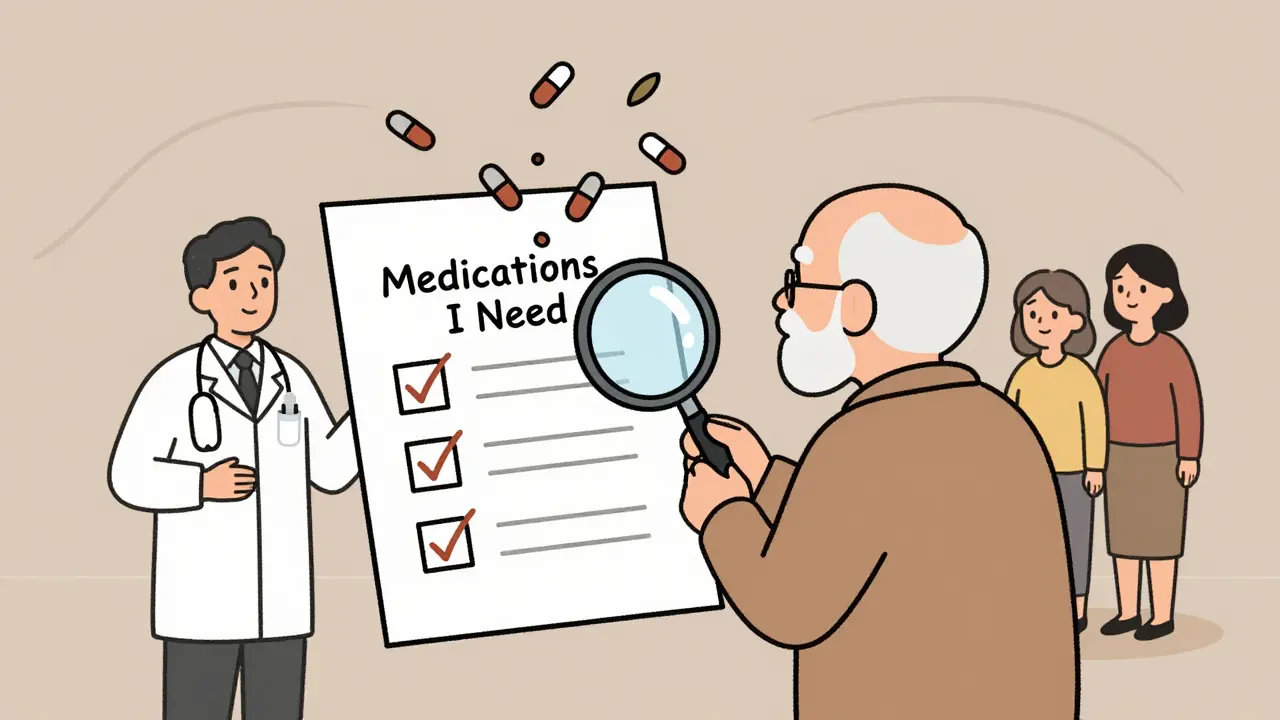
Deprescribing isn’t just stopping a drug. It’s a planned, step-by-step process to safely reduce or eliminate medications that no longer provide clear benefits-or may even be causing harm. The American Geriatrics Society defines it as: "the planned and supervised process of dose reduction or stopping of medication that might be causing harm, or no longer be of benefit." This isn’t a guess. It’s a clinical decision, grounded in evidence, patient goals, and ongoing monitoring.Think of it like this: if you started a medication at 60 to prevent a heart attack, and now you’re 85 with advanced dementia and limited life expectancy, does that same pill still make sense? Maybe not. The goal isn’t to cut drugs for the sake of cutting them. It’s to match treatment to current health, function, and what matters most to the patient.
The Five Steps of a Safe Deprescribing Plan
There’s no magic formula, but there is a proven framework. Leading guidelines from the American Academy of Family Physicians and the Canadian Deprescribing Guidelines Initiative outline five clear steps:- Identify potentially inappropriate medications-These are drugs flagged in tools like the Beers Criteria, such as long-term benzodiazepines, anticholinergics, or proton pump inhibitors used beyond six months without clear indication.
- Determine if the drug can be reduced or stopped-Ask: Is the benefit still outweighing the risk? Is the patient’s condition stable? Are they still alive long enough to benefit?
- Plan a taper-Never stop cold turkey. Drugs like antidepressants, beta-blockers, or steroids need gradual reduction to avoid withdrawal symptoms like rebound anxiety, high blood pressure, or adrenal crisis.
- Monitor closely-Watch for return of original symptoms, new side effects, or signs of improved well-being. A patient might feel clearer-headed or sleep better after stopping a sedating antihistamine they’d been on for years.
- Document everything-Record what was stopped, why, how it was tapered, and what happened afterward. This protects the patient and informs future care.
Each step requires conversation-not just with the doctor, but with the patient and often the pharmacist. A 2023 study found that patients are far more likely to agree to deprescribing when they’re part of the decision, not just told what to do.
Who Benefits Most from Deprescribing?
Not everyone needs it. But certain groups stand to gain the most:- Older adults taking five or more medications (about 40% of seniors in the U.S.)
- Those with frailty, dementia, or end-stage disease
- Patients recently hospitalized-many get new prescriptions during stays, then go home with a pile of pills they don’t need
- People experiencing new symptoms like dizziness, confusion, or falls that could be drug-related
- Those on preventive drugs with no clear short-term benefit, like statins in very elderly patients with limited life expectancy
One of the most powerful examples comes from a 2023 trial in primary care clinics. Researchers identified seniors on multiple blood pressure medications, many with normal readings. After carefully tapering one drug at a time, 70% of patients maintained stable blood pressure with fewer pills. More importantly, their fall risk dropped by 30%-a direct result of reducing dizziness-causing drugs.
What Does the Research Say About Outcomes?
The data is growing, and it’s encouraging-but not perfect.A major 2023 review in JAMA Network Open analyzed 41 studies involving over 12,000 older adults. The results? Deprescribing reduced the average number of medications per person by about 1.5 pills. Sounds small? Consider this: in a practice with 2,000 patients, that’s over 140 unnecessary pills stopped each year. That’s not just cost savings-it’s fewer side effects, fewer ER visits, fewer hospitalizations.
But here’s the catch: most studies measured medication count, not clinical outcomes like falls, cognition, or survival. That’s a gap researchers are now trying to close. Dr. Dan Gnjidic, a leading expert, points out: "We’ve shown we can reduce pills. Now we need to prove we’re improving how people feel and live."
Still, the signs are strong. Systematic reviews from the Agency for Healthcare Research and Quality show deprescribing is linked to:
- Reduced risk of falls
- Improved mental clarity and alertness
- Lower rates of hospital admission
- Decreased drug-related adverse events
- Higher patient satisfaction
One 2022 study followed patients who stopped long-term proton pump inhibitors (PPIs). Many had been on them for over a decade for mild heartburn. After stopping, only 20% needed them again within six months. The rest did fine-without the increased risk of bone fractures, kidney issues, or gut infections tied to long-term PPI use.
Why Isn’t Deprescribing Done More Often?
The science is clear. The tools exist. So why are so many people still on drugs they don’t need?First, there’s inertia. Prescribing is routine. Deprescribing requires work. It means reviewing every pill, checking guidelines, talking to patients, scheduling follow-ups. Most clinics don’t have the time or systems to do it.
Second, fear. Doctors worry about backlash. "What if they get worse?" Patients worry too. "If I stop this, will I die?" Many assume every pill is a shield. The truth? Some are just clutter.
Third, fragmented care. A patient sees a cardiologist, a neurologist, a rheumatologist-each adds a drug. No one steps back to see the full picture. A 2024 study in the Journal of the American Geriatrics Society found that patients with five or more prescribers were 3 times more likely to be on inappropriate medications.
And fourth, no one asks. A 2019 survey by the American Academy of Family Physicians found that 85% of older adults would be open to taking fewer medications-if their doctor brought it up. But only 12% said their doctor ever did.
What’s New in 2025?
The field is evolving fast. In 2024, researchers launched pilot programs using AI tools to scan electronic health records and flag high-risk medication combinations in real time. One pilot in a Midwest health system reduced potentially inappropriate prescriptions by 15% in just six months.Another breakthrough? Personalized deprescribing. Early studies are looking at genetic markers that affect how people metabolize drugs. For example, some patients carry a gene variant that makes them ultra-sensitive to benzodiazepines. For them, even low doses can cause confusion or falls. Genetic testing could soon help identify who should stop these drugs before they even start.
Tools like deprescribing.org, which has been downloaded over half a million times, now offer patient-friendly guides, conversation starters, and tapering schedules. Pharmacists are stepping into lead roles-many now offer free medication reviews for seniors.
The American Geriatrics Society updated its Beers Criteria in 2023 to include new warnings on antipsychotics for dementia, long-term opioids, and multiple sedatives. These aren’t just lists-they’re action items.
What Can You Do?
If you or a loved one is on five or more medications:- Ask your doctor: "Which of these are still necessary?"
- Bring all pills to your appointment-supplements, OTCs, and vitamins too.
- Ask: "What happens if we stop this?" and "What are the risks of keeping it?"
- Don’t stop anything on your own. Tapering safely matters.
- Request a medication review with your pharmacist-they’re trained to spot problems.
Deprescribing isn’t about giving up treatment. It’s about choosing better treatment. It’s about making sure every pill you take still has a reason to be there. In a world where more drugs are often seen as better, the real innovation is knowing when to stop.
Is deprescribing safe?
Yes, when done properly. Deprescribing follows a structured, monitored process-not random stopping. Studies show that most patients tolerate medication reduction well, and many report feeling better afterward. Withdrawal symptoms can occur but are rare when tapering is done gradually and under supervision. The risk of harm from continuing unnecessary medications is often higher than the risk of stopping them.
Can deprescribing cause rebound symptoms?
It can, but only with certain drugs. Medications like beta-blockers, antidepressants, and benzodiazepines require slow tapering to avoid rebound effects such as increased heart rate, anxiety, or insomnia. That’s why deprescribing isn’t about quitting cold turkey-it’s about planned, step-by-step reduction with follow-up. Your provider will guide you through the safest approach based on the drug and your health.
Does deprescribing increase the risk of death?
No. In fact, the opposite is true. A 2023 meta-analysis in JAMA Network Open found no increase in mortality among patients who underwent deprescribing. Some studies even showed lower death rates, especially when high-risk drugs like sedatives or antipsychotics were stopped. The danger lies in continuing medications that no longer help-and may cause harm, like falls or organ damage.
What if my symptoms come back after stopping a medication?
That’s why monitoring is part of the process. If symptoms return, your doctor will assess whether it’s the drug coming back or something else. Sometimes, the original issue was misdiagnosed, or the medication was masking another problem. In most cases, symptoms that return after stopping a drug are mild and temporary. If they persist, the medication can be restarted at a lower dose or replaced with a safer alternative.
Who should lead the deprescribing process?
Your primary care provider should lead, but it’s a team effort. Pharmacists play a key role in reviewing all medications and spotting interactions. Specialists should be consulted if a drug was prescribed for a specific condition. Nurses and care coordinators help with follow-up. And most importantly, the patient must be involved-your goals, values, and concerns guide every decision.
Is deprescribing only for older adults?
While most common in older adults due to polypharmacy, deprescribing applies to anyone on long-term, unnecessary, or harmful medications. Younger people with chronic conditions, those on multiple psychiatric drugs, or individuals taking OTC sleep aids or pain relievers daily can also benefit. The principle is the same: are the benefits still worth the risks?
What Comes Next?
The future of deprescribing lies in integration. Imagine an electronic health record that flags outdated prescriptions during every visit. Pharmacists routinely reviewing all meds at discharge. Patients getting annual "medication checkups" just like dental cleanings. These aren’t futuristic ideas-they’re already being tested in clinics across North America.As the population ages, and as we learn more about how drugs interact over decades, deprescribing won’t be optional. It’ll be standard. The goal isn’t fewer pills for the sake of fewer pills. It’s better health, clearer thinking, fewer falls, and more years lived well-not just lived.
Comments
Dee Humprey
I've seen this happen with my mom. She was on 12 meds at 82. After a careful taper, they cut 4. She started sleeping through the night for the first time in years. No more confusion. No more falls. Just her back again.
January 3, 2026 AT 12:30
Peyton Feuer
i just had my grandpa go through this and wow it was like night and day. he kept saying he felt 'foggy' but never connected it to his meds. once they dropped the benzos and the antihistamine, he was cracking jokes again. why isn't this standard practice??
January 3, 2026 AT 18:28
Siobhan Goggin
This is so important. So many elderly patients are just drifting along on autopilot prescriptions. Someone needs to be the adult in the room and ask: does this still make sense?
January 5, 2026 AT 16:23
Jay Tejada
lol the system is designed to keep prescribing. doctors get paid for visits, not for stopping pills. pharmacists get paid for dispensing. nobody gets paid for saying 'you don't need this anymore'.
January 7, 2026 AT 04:06
John Wilmerding
The framework outlined here is clinically sound and aligns with current guidelines from the American Academy of Family Physicians. The emphasis on patient-centered decision-making and gradual tapering is critical to minimizing iatrogenic harm. I would only add that shared decision-making tools, such as decision aids, should be routinely integrated into primary care workflows.
January 8, 2026 AT 03:39
saurabh singh
In India, we see this too. Grandmas on 8 pills for 'everything' - blood pressure, cholesterol, arthritis, sleep, anxiety, heartburn, then another for the side effects. One grandma stopped her statin after her son showed her the data. She said, 'I’m 84, I want to taste my chai without feeling like a zombie.' And she did. No heart attack. Just better chai.
January 10, 2026 AT 02:46
jigisha Patel
This is dangerous pseudoscience. Medications are prescribed based on evidence, not sentiment. Reducing drugs without rigorous monitoring invites catastrophic outcomes. You’re glorifying neglect under the guise of 'wellness'.
January 10, 2026 AT 09:21
Shanna Sung
They're lying about this. Big Pharma doesn't want you to stop taking pills. That's why they fund 'deprescribing' studies - to make you think it's safe so they can sell you new ones later. They already know the real truth: all drugs are poison. You just don't know it yet.
January 11, 2026 AT 22:47
Ethan Purser
I’ve been on 7 meds for 15 years. I stopped 3 last year. I cried. Not because I was scared - because I finally felt like myself again. For the first time since I was 40. This isn’t medicine. This is resurrection.
January 12, 2026 AT 08:23
Vikram Sujay
The philosophical underpinning of deprescribing resonates with the ancient Indian concept of 'tyaga' - the renunciation of excess. Just as one must shed material attachments to attain clarity, so too must the body be freed from pharmacological clutter to restore natural equilibrium. The modern medical paradigm, however, remains rooted in interventionism rather than discernment.
January 13, 2026 AT 05:43
Brendan F. Cochran
So now we're supposed to trust some doctor who says 'stop your heart med' because some study says so? In my day, you took what the doc gave you and shut up. This is why America's falling apart - everyone thinks they know better than the experts. My dad's on that blood pressure pill and he's still walking. Don't touch it.
January 13, 2026 AT 23:59
Doreen Pachificus
I wonder if anyone’s tracked how many people get prescribed something new right after they stop a med. Like, they stop the sleeping pill, then get an anxiety med, then a GI med because the anxiety med messed with their stomach. It’s just pill roulette.
January 15, 2026 AT 09:35