
How Sleep Disruption Affects Weight Gain: The Science of Circadian Rhythm and Metabolism
- Colin Hurd
- 28 January 2026
- 11 Comments
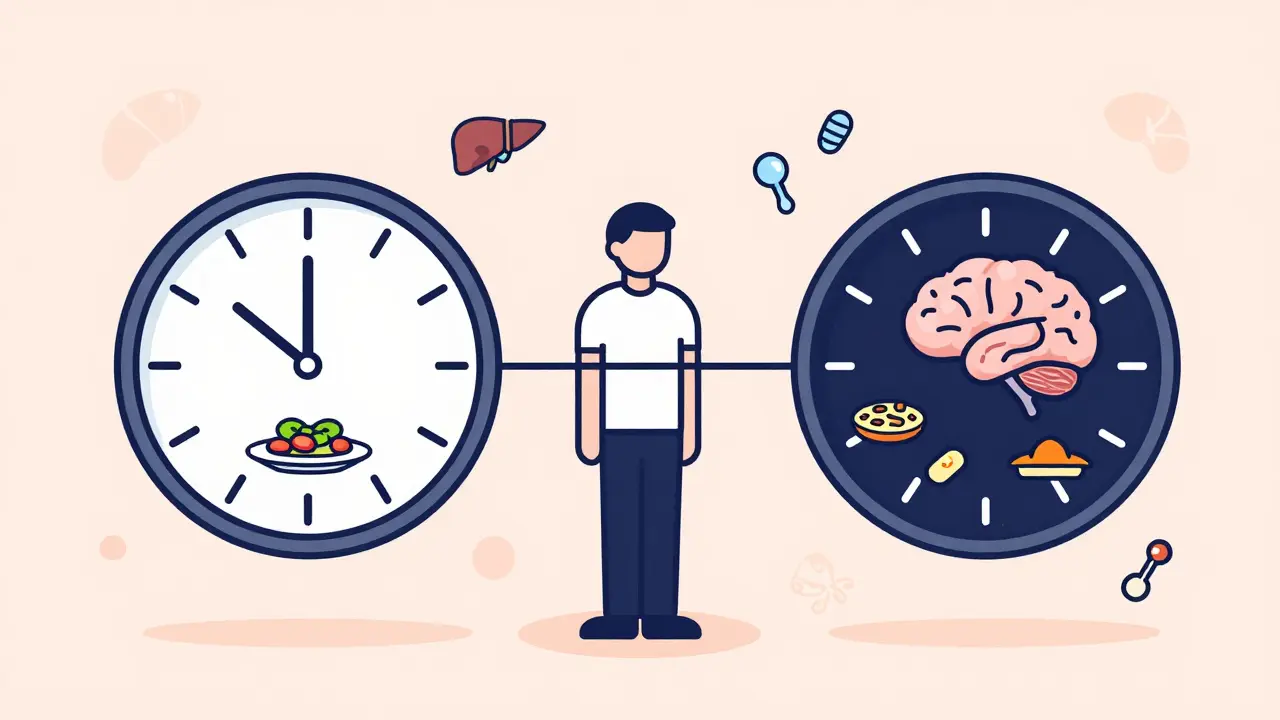
Most people think weight gain is just about eating too much or not exercising enough. But what if the real problem isn’t your plate-it’s your sleep schedule? If you’ve tried cutting calories, hitting the gym, and still can’t lose weight, your body’s internal clock might be the missing piece. Circadian rhythm-the 24-hour biological cycle that controls sleep, hunger, and metabolism-isn’t just about feeling tired. It’s the silent driver behind how your body burns calories, stores fat, and responds to food.
Why Your Body Gets Confused at Night
Your body runs on a clock. Not the one on your wall, but a complex network of genes and hormones that tell your liver when to process sugar, your fat cells when to release energy, and your stomach when to feel full. This system, called the circadian rhythm, evolved to match your daily routine: awake in daylight, asleep at night. But modern life-late-night scrolling, shift work, midnight snacks-throws it off. When your sleep and eating times clash with your body’s natural rhythm, you get what scientists call circadian misalignment. This isn’t just feeling groggy. It’s a metabolic mess. Studies show that when people eat late at night or work overnight shifts, their bodies become less efficient at using energy. One 2014 study found that night shift workers burned about 55 fewer calories per day-even when they ate the same amount as day workers. That’s like eating an extra cookie every single day without realizing it.The Double Whammy: Less Energy Burn, More Hunger
Sleep deprivation doesn’t just make you tired. It rewires your brain’s reward system. When you’re short on sleep, your brain craves high-carb, high-fat foods more than ever. A 2016 study from the University of Chicago showed that people who slept only four hours a night for four days had a 22% increase in appetite-and a 33% stronger urge for sugary, starchy snacks. Brain scans revealed that their reward centers lit up like Christmas trees when they saw images of pizza, cookies, and chips. At the same time, your body burns fewer calories. Even when you’re resting, your metabolism slows down after poor sleep. The thermic effect of food-the energy your body uses to digest meals-drops by nearly 17% when you eat dinner late. Combine that with the fact that your body becomes less sensitive to insulin (by 20-25%) during nighttime hours, and you’ve got the perfect storm: more calories eaten, fewer burned, and more stored as fat.Shift Workers and the Hidden Weight Gain Epidemic
One in five workers worldwide does shift work. Nurses, truck drivers, factory staff, and emergency responders are especially vulnerable. A 2022 review in Nature Reviews Endocrinology confirmed that shift workers gain weight faster than day workers-even when their diets are identical. One nurse with 12 years of night shifts told a Reddit forum: “I gained 35 pounds in my first year. I didn’t eat more-I just couldn’t stop snacking at 3 a.m. My body wanted to be asleep, but my stomach was wide awake.” Research backs this up. A study tracking 285,000 people found that circadian disruption accounts for 5-10% of obesity risk in shift workers, independent of diet and exercise. That’s not a small number. It’s like adding a daily dessert to your routine without even knowing it.Time-Restricted Eating: The Simple Fix
There’s a solution that doesn’t require starving yourself or running marathons: time-restricted eating (TRE). This means limiting all food intake to a 10-hour window or less during daylight hours. For example: eat only between 8 a.m. and 6 p.m., then fast until the next morning. A 2019 study from the Salk Institute found that overweight adults who followed a 10-hour eating window lost 3-5% of their body weight in 12 weeks-without changing what they ate. Why? Because eating during daylight aligns with your body’s natural metabolic rhythm. Your liver, pancreas, and gut work best in sync with sunlight. When you eat late, those organs are still half-asleep. The best part? You don’t need to count calories. Just stop eating earlier. In a 2022 survey of 450 people using the Zero app, those who ate within a 10-hour window lost 3.2 kg (7.1 lbs) more than those who didn’t-and 74% said nighttime cravings vanished.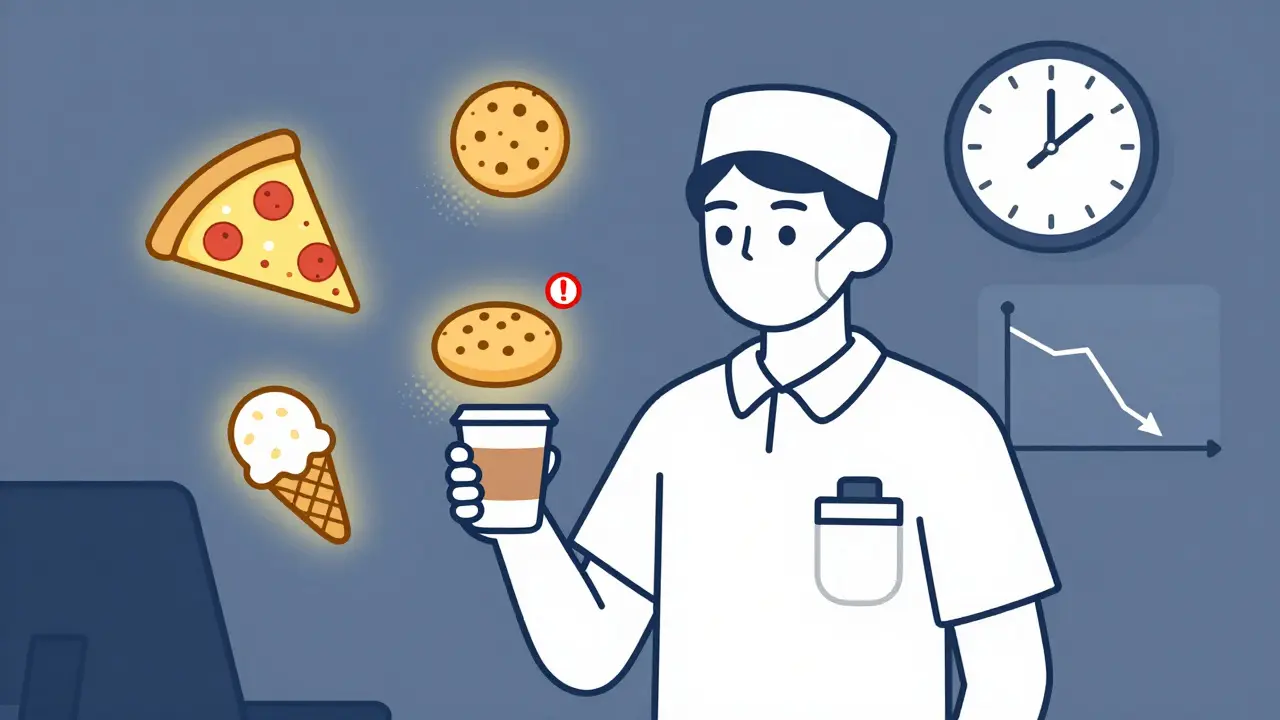
Not Everyone Has the Same Clock
You’re not a one-size-fits-all. Some people are “morning larks,” naturally alert at sunrise. Others are “night owls,” peaking after midnight. Your chronotype matters. A 2020 study in Obesity found that morning types lost 23% more weight when they ate early (8 a.m.-6 p.m.) compared to night owls. Night owls did better with a later window (10 a.m.-8 p.m.). Try this: Track your energy levels for a week. When do you feel most alert? When do you feel hungriest? Use that as a guide. Don’t force yourself into a 7 a.m.-5 p.m. window if you’re still yawning at 9 a.m. Your body knows its rhythm. You just need to listen.Why This Works Better Than Just Dieting
Traditional weight loss advice focuses on calories in versus calories out. But that ignores timing. You can eat 1,800 calories at 10 a.m. and 4 p.m. and burn them efficiently. Or eat the same 1,800 calories at 11 p.m. and 2 a.m.-and your body stores 20% more as fat. Circadian-based approaches don’t ask you to eat less. They ask you to eat at the right time. That’s why they’re more sustainable. People don’t quit TRE because they’re hungry. They quit because they can’t stick to it socially. But once you adjust-after 2-4 weeks-the cravings fade. Your body learns when to expect food, and when to rest.Real-World Success Stories
Kaiser Permanente ran a pilot program for night shift workers in 2021. They didn’t change diets. They didn’t add gym memberships. They just moved meals to earlier in the shift and used bright light therapy to reset circadian clocks. Result? Weight gain dropped by 42%. On the flip side, people who try to fix their sleep but can’t stick to it often get frustrated. One user wrote in a Sleep Cycle app review: “The science is sound, but with my variable hours, I’ve tried for two years with minimal success.” That’s real. Life isn’t perfect. But you don’t need perfection. Even shifting your eating window by two hours earlier, three days a week, makes a difference.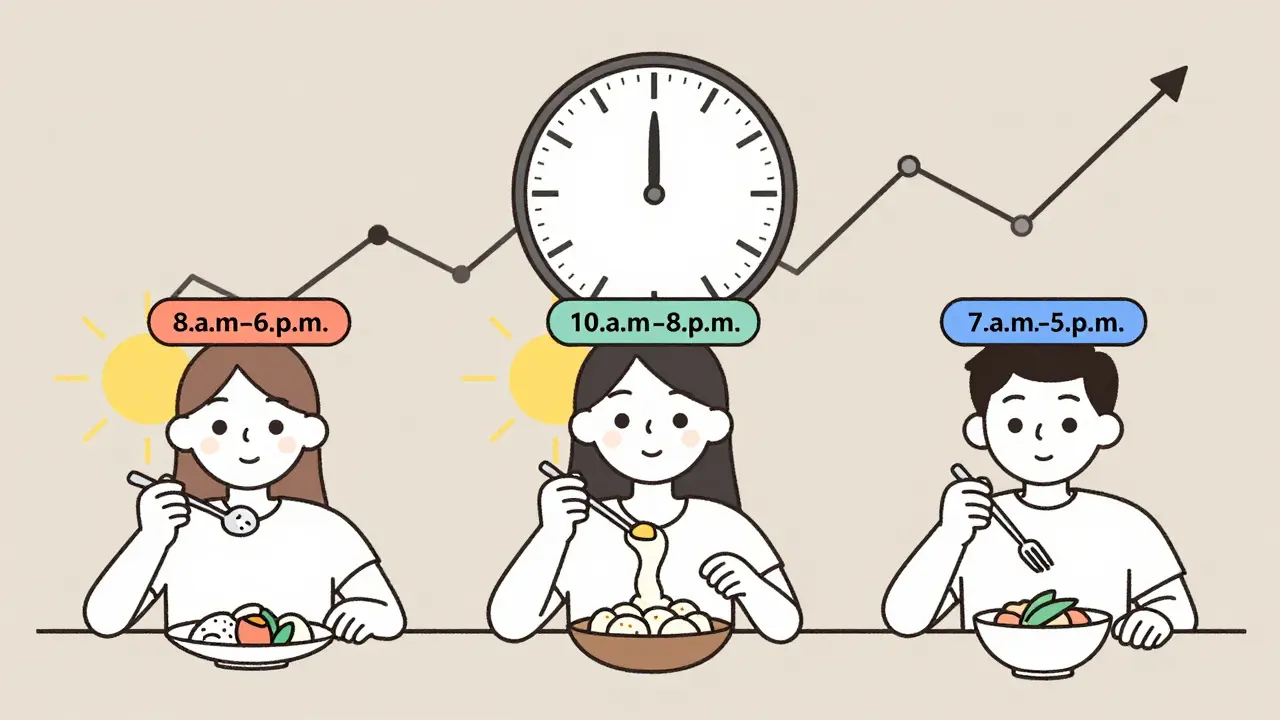
What’s Next? Wearables and Personalized Sleep
The future of weight management isn’t just about calories. It’s about timing. Fitbit’s 2024 update now includes a “Circadian Alignment Score” that predicts 18% of your weight change based on your sleep and activity patterns. The NIH has invested $185 million over the next four years to build tools that measure your personal circadian rhythm using saliva samples and wearable sensors. The FDA even updated its guidelines in 2023 to require drug trials for obesity to test how timing affects results. This isn’t a trend. It’s science becoming standard.Start Today: 3 Simple Steps
You don’t need a lab test or a personal trainer. Here’s how to begin:- Set a 10-hour eating window. Pick the hours that fit your life. If you wake at 7 a.m., eat from 8 a.m. to 6 p.m. If you’re a night owl, try 10 a.m. to 8 p.m.
- No food after your window closes. Water, black coffee, or unsweetened tea are fine. No snacks, no late-night ice cream.
- Keep sleep and wake times consistent. Even on weekends. A 30-minute shift is okay. More than that? It resets your clock.
Why This Matters Long-Term
The World Health Organization says circadian-based strategies could reduce global obesity rates by 5-8% if widely adopted. That’s millions of people. Not because they went on a diet. But because they slept better and ate earlier. This isn’t about willpower. It’s about biology. Your body isn’t broken. It’s just out of sync. Fix the rhythm, and the weight follows.Can poor sleep cause weight gain even if I eat healthy?
Yes. Even if you eat healthy foods, sleeping poorly or eating late at night disrupts your metabolism. Your body becomes less efficient at burning calories and more likely to store fat. Studies show that people who sleep less than 6 hours a night consume over 250 extra calories daily-mostly from snacks-and burn fewer calories overall, leading to weight gain regardless of food quality.
Is time-restricted eating the same as intermittent fasting?
They’re similar, but not the same. Intermittent fasting often focuses on calorie restriction or long fasting windows (like 16:8). Time-restricted eating (TRE) focuses on aligning meals with your body’s natural rhythm-eating during daylight hours, regardless of total calories. TRE works because it syncs with your circadian clock, not just because you’re eating less.
I work nights. Can I still use circadian rhythm to lose weight?
Absolutely. The key is consistency. If you work nights, sleep during the day, and eat your main meals during your active hours-even if that’s 7 p.m. to 5 a.m.-you can still align with your internal clock. Avoid eating right before sleep. Use bright light during your shift and darkness during sleep to reinforce your rhythm. Studies show shift workers who follow this pattern lose weight more easily than those who eat randomly.
How long does it take to see results from better sleep and eating timing?
Most people notice reduced nighttime cravings and better sleep within 3-5 days. Weight loss typically starts after 2-4 weeks. A 2019 study found participants lost 3-5% of body weight in 12 weeks just by eating within a 10-hour window. The key is consistency-not perfection.
Does caffeine or alcohol affect circadian rhythm?
Yes. Caffeine after 2 p.m. can delay your sleep clock by up to 40 minutes. Alcohol might make you fall asleep faster, but it fragments sleep and suppresses REM cycles, which disrupts metabolic repair. Both throw off your circadian rhythm, making it harder for your body to regulate hunger and energy use. For best results, avoid caffeine after noon and alcohol within 3 hours of bedtime.


Comments
Paul Adler
Interesting read. I never thought about how late-night snacking could be sabotaging my metabolism. I used to think it was just about calories, but this makes me wonder if my 2 a.m. yogurt habit is secretly turning me into a fat storage unit.
January 28, 2026 AT 19:05
Ryan Pagan
Yo, this is the real deal. I tried TRE after reading this and lost 8 lbs in three weeks without changing a single bite of food. Just stopped eating after 7 p.m. My cravings? Gone. My sleep? Better. My jeans? Looser. Science isn’t magic-it’s just biology you’ve been ignoring.
January 29, 2026 AT 22:03
Laia Freeman
OMG YES I’VE BEEN DOING THIS FOR 2 WEEKS AND I’M NOT CRAZY HUNGRY AT MIDNIGHT ANYMORE?? LIKE I ACTUALLY FORGOT I EVEN WANTED ICE CREAM??
January 30, 2026 AT 07:07
Robin Keith
Let’s be honest-this isn’t about ‘timing,’ it’s about the metaphysical dissonance between human biology and the capitalist grind. We’ve been engineered to be awake when the sun’s up, but our society forces us to be productive when our cortisol levels are in the toilet, our melatonin is screaming, and our mitochondria are filing for divorce. We’re not lazy-we’re chronically misaligned. And the fact that Big Pharma hasn’t patented ‘sleep hygiene’ as a drug tells you everything you need to know about the corruption of wellness.
January 30, 2026 AT 14:48
Kristie Horst
How charming. So now we’re supposed to believe that the solution to obesity is simply… not eating after 6 p.m.? How quaint. Meanwhile, millions of people work night shifts, care for sick relatives, or live in households where dinner isn’t served until 9 p.m.-and they’re just supposed to starve themselves to match some arbitrary circadian ideal? The privilege in this ‘solution’ is breathtaking. Let’s not mistake convenience for science, and let’s not pretend that everyone has the luxury of a 10-hour eating window.
January 30, 2026 AT 16:33
Megan Brooks
Kristie raises a valid point. While the science behind circadian alignment is compelling, the one-size-fits-all framing of this article ignores socioeconomic realities. For many, meal timing is dictated by work schedules, childcare, or cultural norms-not personal preference. A more inclusive approach would acknowledge that ‘optimal timing’ must be adapted, not imposed. The goal should be flexibility within rhythm, not rigid conformity.
February 1, 2026 AT 02:51
Doug Gray
Okay but… have you even read the NIH grant proposals? The circadian alignment score is basically a glorified Fitbit guess with a fancy name. Also, ‘time-restricted eating’ is just intermittent fasting with a TED Talk makeover. We’re just repackaging old ideas with biobabble and calling it innovation. 🤷♂️
February 2, 2026 AT 11:02
LOUIS YOUANES
Oh wow, another ‘science’ article that ignores the fact that most people don’t have the mental bandwidth to track their circadian rhythm while juggling three jobs and a toddler. You want me to eat between 8 a.m. and 6 p.m.? Cool. My kid’s bedtime is 8:30 p.m. and I eat dinner with him. What am I supposed to do-starve until 10 p.m. and then wake up at 4 a.m. to ‘align’? This isn’t wellness. It’s guilt with a lab coat.
February 4, 2026 AT 09:24
paul walker
I tried TRE and it worked but I kept forgetting to drink water and ended up dehydrated and dizzy. So now I just eat earlier and drink more H2O. No fancy app needed. Also, I’m not a morning person but I still do 8am-6pm because my body just… feels better. I’m not perfect but I’m better!
February 6, 2026 AT 06:49
rajaneesh s rajan
Bro, in India we eat dinner at 9 p.m. and sleep at 1 a.m. and still don’t gain weight. Why? Because we eat home-cooked food, not processed crap. This isn’t about timing-it’s about what you eat. Also, my cousin works night shifts and eats at 3 a.m. and he’s jacked. Circadian rhythm? Maybe. But maybe it’s just calories in vs out after all.
February 7, 2026 AT 07:47
Andy Steenberge
Let’s not throw the baby out with the bathwater. The science here is robust-multiple peer-reviewed studies confirm that circadian misalignment impairs glucose metabolism and increases fat storage, regardless of total calories. But Kristie and Louis are right: this isn’t a universal fix. The key is adaptation. If you’re a night shift worker, align your eating window with your active hours, not the sun. If you’re a parent, eat with your family-even if it’s late-and prioritize consistency over perfection. The goal isn’t to be a circadian purist. It’s to be in tune with your own rhythm. That’s sustainable. That’s real.
February 8, 2026 AT 14:03